← Some species are all female and they still make babies
Teacher guide
Whiptail lizards, the Brahminy blind snake, the Amazon molly and some salamanders belong to species where every adult is female. Students find out why babies made by parthenogenesis are near copies of their mom, why some all-female fish and salamanders still need sperm from another species, why two female whiptails act out mating, and how one Brahminy blind snake can start a new population by herself. Teach it right after the Coquita lesson.
At a glance
- Middle school
- Grades 7 to 8 · About 21 minutes
- High school
- Grades 9 to 12 · About 31 minutes
- College
- College · About 33 minutes · A calculator or scratch paper
- Materials
- The worksheet for your level, a screen for the video, a calculator or scratch paper for the college worksheet.
- Grouping
- Students work alone. For partners, pair students for Questions.
- The phenomenon
- Whiptail lizards, the Brahminy blind snake and some fish and salamanders have no males at all, and they keep making babies generation after generation.
- Topics covered
- Reproduction, parthenogenesis, eggs and sperm, DNA passed from mother to daughter, mutations, mating-like behavior between females, ovulation, starting a new population.
Preview the video before sharing it with your class.
Video and transcripts
- 1
Some species are all female and they still make babies
Introduces whiptail lizards, the Brahminy blind snake, and fish and salamanders that still need a male to start their eggs.
Watch on YouTubeTranscript
Transcribed from the posted video on YouTube.
Some species are all-female, no males. Where do the babies come from? Scientists call these unisexual species.
How does an all-female species make babies? Parthenogenesis. That’s making babies without fertilization. And the babies are near-genetic copies of the mom, because there’s no dad adding DNA to the mix.
There are parthenogenetic snakes, like the Brahminy blind snake, that get passed around the world through flower pots. Some gecko species have all-female lineages too.
In truly parthenogenetic species, every adult is female. Mothers, daughters, granddaughters. Most of the time, all-female means they don’t need males at all. But there are exceptions.
There are all-female fish lineages and all-female salamander lineages that still need male genetic material as a trigger to start development. These females mate with males of related species. The swimmers switch the development on. And in a lot of cases, the male DNA is left out of the babies entirely.
So in a nutshell, in certain species, every adult in the lineage is female, but she still needs a male from another species to start her eggs.
And in whiptail lizards, which don’t need a male at all, you can still see two females doing mating-like behavior. And that behavior helps to trigger their ovulation.
So if this is new to you, let me know in the comments. Did you already know this? Did it blow your mind too? I’m Dr. Raven Baxter, your favorite scientist. Follow me for more science. Bye!
Your word of the day is
yoo-nih-SEK-shoo-ul
Unisexual. Having only one sex. Every unisexual animal with a backbone that scientists have found is all female.
| Word | Parts | Meaning |
|---|---|---|
| unisexual | Latin ūni- (one) + sexual | having only one sex |
| gynogenesis (the molly) | Greek gynḗ (woman) + genesis (origin) | an egg needs sperm to start growing, but the sperm’s DNA almost never joins the egg’s DNA |
| kleptogenesis (the salamanders) | Greek kléptēs (thief) + genesis | borrowing sperm from another species, sometimes keeping some of the male’s DNA |
Same roots, other subjects
- MathUnilateral means involving one side.
- MusicVoices in unison share a single sound, from Latin for “of a single sound.”
- World languagesGreek uses mono- for the same idea of one, as in monologue.
- HealthA gynecologist is a doctor for women’s reproductive health, from the same gyn- root.
- EnglishKleptomania, an urge to steal, shares the thief root with kleptogenesis.
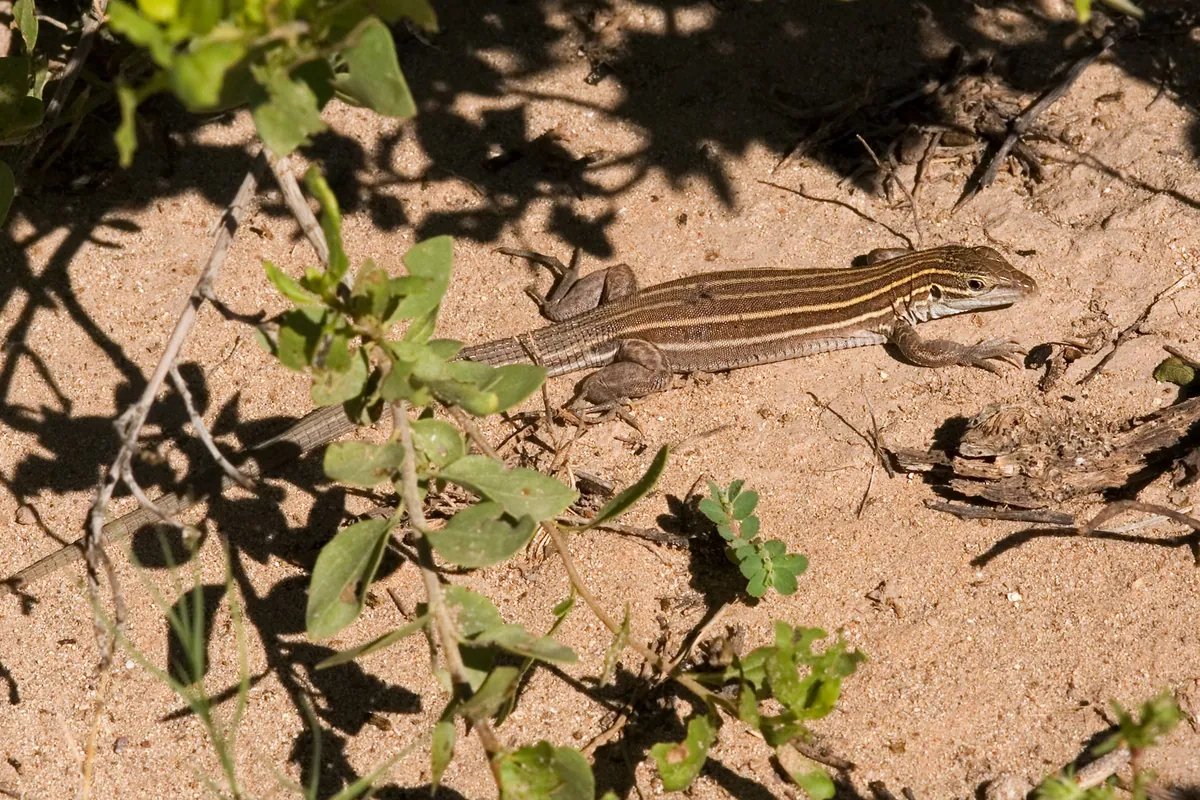
- BiologyThe desert grassland whiptail’s scientific name, Aspidoscelis uniparens, refers to the single parent each lizard has.
Word hunt. Ask students to find three more words starting with uni- or mono- and say what is single in each one.
Parthenogenesis, the word of the day in the Coquita lesson, also appears in this video.
Lesson flow
- 3 minPredictStudents answer the question and write one sentence.
- About 2 minVideo
- 3 minWord of the dayBreak the word into its parts together.
- 8 minQuestionsStudents answer on their own, then share out. With partners, pairs discuss first.
- 5 minExit ticket
- 3 minPredictStudents answer the question and write one sentence.
- About 2 minVideo
- 3 minWord of the dayBreak the word into its parts together.
- 8 minQuestionsStudents answer on their own, then share out. With partners, pairs discuss first.
- About 10 minClaim, evidence, reasoningStudents decide whether the Amazon molly counts as an all-female species, then write one question about a molly baby’s DNA that would test the claim.
- HomeworkGoing further
- 5 minExit ticket
- About 2 minVideo
- 3 minWord of the dayBreak the word into its parts together.
- 3 minPredict
- 20 minRead the paperStudents read Table 1 of the paper, fill in the percent column and answer the questions. The paper reading works as homework or a discussion section.
- 5 minExit ticket
Video simplifications
- Near copies
- The video says the babies are near-genetic copies of the mom. Lampert and Schartl note that mutations still produce new genotypes in all-female species, and Lu and colleagues report many Amazon molly clone lines that differ through mutation. On the high school worksheet, Questions 1 brings in mutations.
- True parthenogenesis
- Lampert and Schartl use the term true parthenogenesis, babies from virgin females with no males at all, only for all-female lizards and the one all-female snake known. The fish and salamanders reproduce in leakier ways. In gynogenesis, as in the Amazon molly, sperm starts the egg and the male’s DNA is usually left out. In kleptogenesis, as in the all-female mole salamanders, part or all of one of the mother’s genomes is sometimes swapped for the male’s.
- Mating-like behavior
- Crews and colleagues measured the effect in lab chambers. The Toronto Zoo notes that the behavior seems to stimulate reproduction in captivity, but its importance in the wild is not known. The college exit ticket asks students to spot that gap.
- Whiptail names
- The 1986 Crews paper uses the older genus name Cnemidophorus, and Newton and colleagues use Aspidoscelis. The Reptile Database lists Cnemidophorus uniparens under the desert grassland whiptail, Aspidoscelis uniparens, and explains that the name uniparens refers to “the single parent each individual has.”
Worksheet
Predict
In some species of lizards, snakes, fish and salamanders, every adult is female. There are zero males. Could a species with no males keep having babies for thousands of years?
Circle one. Yes / No
Watch
- Some species are all female and they still make babiesyoutube.com/shorts/usPB5PGeb0E
Word of the day
Unisexual (yoo-nih-SEK-shoo-ul). Having only one sex. Every unisexual animal with a backbone that scientists have found is all female.
| Word part | Comes from | Meaning |
|---|---|---|
| uni- | Latin ūnus | one |
| -sexual | Latin sexus | sex |
- A unicycle has one wheel.
- In music, voices singing in unison share a single sound. The word comes from Latin for “of a single sound.”
Questions
Whiptail lizards make babies by parthenogenesis, making babies without fertilization. In the video, Raven says whiptail babies are near copies of their mom. Why are whiptail babies near copies of their mom? And what’s one good thing about a species where every adult is female?
Hint. Think about who adds DNA to a baby. Then think about how many adults in the species can lay eggs.
The Amazon molly is a fish. She needs sperm from a male of a different species to start her eggs. But her babies almost never get any of his DNA. Does the Amazon molly still count as an all-female species? Give your reason.
Hint. Every Amazon molly is female, and her babies are almost always copies of their mom. How often does the male’s DNA end up in the babies?
Whiptails don’t need males. But sometimes two female whiptails act like they are mating. How could you test if mating-like behavior between two females helps whiptails have babies?
Hint. Picture two groups of lizards. What would you change between the groups? What would you count?
The Brahminy blind snake spread around the world in the soil of potted plants. How does having no males help the Brahminy blind snake start a new group in a new place?
Hint. If no male is needed, how many snakes does it take to start a new group?
Exit ticket
In the video, Raven says some all-female fish need sperm from a male of another species to start their eggs. She also says two female whiptails act out mating-like behavior, even though whiptails need no male. What does the male’s sperm do for an all-female fish’s egg? And why do two female whiptails act out mating?
Hint. For the fish, think about whose DNA ends up in her babies. For the whiptails, think about what the behavior helps their bodies do.
Predict
In some species of lizards, snakes, fish and salamanders, every adult is female. There are zero males. Could a species with no males keep having babies for thousands of years?
Circle one. Yes / No
Watch
- Some species are all female and they still make babiesyoutube.com/shorts/usPB5PGeb0E
Word of the day
Unisexual (yoo-nih-SEK-shoo-ul). Having only one sex. Every unisexual animal with a backbone that scientists have found is all female.
| Word part | Comes from | Meaning |
|---|---|---|
| uni- | Latin ūnus | one |
| -sexual | Latin sexus | sex |
- A unicycle has one wheel.
- In music, voices singing in unison share a single sound. The word comes from Latin for “of a single sound.”
Bonus word for question 2. Gynogenesis (jin-uh-JEN-uh-sis) means an egg needs sperm to start developing, but the sperm’s DNA almost never joins the egg’s DNA. It comes from gyno-, from the Greek for “woman,” and -genesis, “origin.”
Questions
In the video, Raven says parthenogenesis is making babies without fertilization, and the babies are near copies of their mom because there’s no dad adding DNA to the mix. A 2010 review by Kathrin Lampert and Manfred Schartl notes that mutations, small changes in DNA, still produce new genotypes in all-female species. Why does a baby made by parthenogenesis carry nearly the same DNA as her mom? And what can make her DNA a little different from her mom’s?
Hint. Start with who adds DNA to the baby. Then think about what can change DNA from one generation to the next.
The Amazon molly needs sperm from a male of another species to start her eggs, but the sperm’s DNA almost never joins the egg’s DNA. A 2010 review by Kathrin Lampert and Manfred Schartl reports that some all-female salamanders also borrow sperm from males of a related species, and their babies sometimes keep part of the male’s DNA. What happens to the male’s DNA in a molly baby and in a salamander baby? And what evidence in a baby’s DNA would show that some of the male’s genes were kept?
Hint. Start with whose DNA ends up in each baby. Then think about what you could compare a baby’s DNA against.
Whiptails don’t need males, yet two females sometimes act out mating behavior. Design a controlled experiment to test whether mating-like behavior between two females helps whiptails reproduce. Name the variable you change, the variable you measure, and a result that would show the behavior helps.
Hint. Picture two groups of females that differ in one way only. Decide what you’d count in each group.
The Brahminy blind snake spread around the world in the soil of potted plants, and females can lay 1 to 8 eggs. Step by step, how could one Brahminy blind snake in one pot start a new population? And why would a two-sex snake species carried in the same pot be less likely to start a population?
Hint. Follow one female and her eggs through two generations. Then think about who has to be in the pot for a two-sex species.
Claim, evidence, reasoning
In the video, Raven says that in certain species every adult is female, but she still needs a male from another species to start her eggs. The Amazon molly is one of these species. A 2010 review by Kathrin Lampert and Manfred Schartl uses the term true parthenogenesis only for all-female lizards and the one all-female snake known, whose eggs start with no male at all. Does the Amazon molly count as an all-female species, even though she needs sperm to start her eggs? Answer with a claim, evidence from the video and this lesson, and your reasoning. Then write one question about a molly baby’s DNA that would test your claim.
Hint. Separate two questions. Who are the adults in the species? What starts the eggs, and whose DNA ends up in the babies?
Going further
A 2016 study by Newton and colleagues found that in New Mexico whiptail lizards, most egg cells stall partway through meiosis. The few egg cells that go on to become eggs start meiosis with twice the usual number of chromosomes, and identical copies pair up with each other. Why does pairing identical copies keep a whiptail baby’s gene mix the same as its mom’s? What does a two-parent baby get that neither a whiptail baby nor Coquita’s baby gets?
Hint. Coquita’s baby lost almost all of her mixed gene pairs. Start with what each kind of baby gets from mom, then think about what a dad adds.
Exit ticket
In the video, Raven says two female whiptails act out mating-like behavior, and the behavior helps trigger ovulation, the release of eggs. In a 1986 study, David Crews’s lab housed females of an all-female whiptail species with one partner each. 18% ovulated when the partner couldn’t act male, and 66% ovulated when the partner acted male. Why would two female whiptails act out mating? And why would natural selection keep the behavior in a species with no males?
Hint. Compare the two percents. Then think about which females would lay more eggs.
Watch
- Some species are all female and they still make babiesyoutube.com/shorts/usPB5PGeb0E
Word of the day
Unisexual (yoo-nih-SEK-shoo-ul). Having only one sex. Every unisexual animal with a backbone that scientists have found is all female.
| Word part | Comes from | Meaning |
|---|---|---|
| uni- | Latin ūnus | one |
| -sexual | Latin sexus | sex |
- A unicycle has one wheel.
- In music, voices singing in unison share a single sound. The word comes from Latin for “of a single sound.”
Bonus word. Gynogenesis (from gyno-, “woman,” and -genesis, “origin”) describes development that sperm triggers without fusion of the sperm and egg nuclei. In the Amazon molly, the sperm’s DNA almost never joins the egg’s DNA.
Predict
In the paper below, David Crews and colleagues housed each female of an all-female whiptail, Cnemidophorus uniparens, with one partner of the same species. One kind of partner was intact. A second kind had her ovaries removed and doesn’t act out mating. A third kind had her ovaries removed and received progesterone, a hormone that makes her act out male mating behavior. Before you read, make a guess. Which partner led the most females to ovulate, and about what percent of females ovulated with each kind of partner? Write one sentence on why you think so.
Hint. In the video, Raven says mating-like behavior helps trigger ovulation. Ask which partner acts most like a male.
Read the paper
Crews, Grassman and Lindzey, “Behavioral facilitation of reproduction in sexual and unisexual whiptail lizards,” PNAS, 1986. The paper is free to read as scanned pages.
David Crews’s team kept two whiptail species from Arizona in lab chambers that copied the light, temperature and humidity of southeastern Arizona in the breeding season. C. inornatus has males and females. C. uniparens is an all-female species that arose from hybrids, and C. inornatus supplied two-thirds of its triploid genome. Each C. inornatus female lived alone, with other females, with a castrated male, or with a castrated male given androgens, hormones that restore male mating behavior. Each C. uniparens female lived with a partner whose ovaries had been removed and who carried an empty capsule, with an intact partner, or with a partner whose ovaries had been removed and who carried a progesterone capsule. Females without ovaries don’t act out mating, but progesterone reliably triggers male-like mating behavior in them. Twice a week, the team felt each lizard’s belly to track her eggs. Table 1 counts the females that ovulated, releasing eggs from the ovary, during the study.
| Species and treatment group in Table 1 | Ovulating | Not ovulating | Percent ovulating |
|---|---|---|---|
| C. inornatus, alone | 0 | 5 | |
| C. inornatus, with other females | 4 | 8 | |
| C. inornatus, with a castrated male | 3 | 9 | |
| C. inornatus, with a castrated male given androgens | 13 | 1 | |
| C. uniparens, with a partner without ovaries and an empty capsule | 2 | 9 | |
| C. uniparens, with an intact partner | 7 | 5 | |
| C. uniparens, with a partner without ovaries and a progesterone capsule | 6 | 3 |
Quantitative reasoning Fill in the percent column. Add the two counts in a row to get the group total, divide the number ovulating by the total, then multiply by 100. What percent of C. uniparens females ovulated with each kind of partner, and about how many times higher was the percent with the progesterone-treated partner than with the partner given an empty capsule?
Hint. Each group’s total is the number ovulating plus the number not ovulating.
Process of science Every C. uniparens partner in the study was a female of the same all-female species. Partners without ovaries got either an empty capsule or a progesterone capsule. Why did the team give one group of partners without ovaries an empty capsule, and what’s one other explanation for the progesterone result that the design leaves open?
Hint. List everything the two kinds of partners share. Then ask what progesterone might change besides behavior.
Evolution In C. inornatus, the species with males, none of the 5 females kept alone ovulated, and 13 of 14 females housed with an androgen-treated male did. The authors write that the C. inornatus line is the maternal ancestor of C. uniparens. How do the two halves of Table 1 support the authors’ idea that the all-female C. uniparens kept a response to mating behavior from its sexual ancestor?
Hint. Compare what raised ovulation in each species. Then ask who acted out mating in each case.
Evolution and systems In intact pairs of C. uniparens, the authors found that one female was past ovulation and acted male, while the other was about to ovulate and acted female. The surge in progesterone after ovulation triggers the male-like behavior, and the two females trade roles as their cycles move along. How do the two females’ hormone cycles let a pair take turns, and why would natural selection keep mating-like behavior in a species with no males?
Hint. Follow one female through one cycle. Then compare the clutches of eggs laid by females alone and in pairs.
Exit ticket
Table 1 counts whiptail females that ovulated with different partners. What does Table 1 show, and what’s one question Table 1 can’t answer?
Hint. Start with the percent column. Then think about where the lizards lived.
Standards
The lesson builds toward four Next Generation Science Standards (NGSS), the most widely used US science standards. Some states, like Texas and Virginia, write their own. NGSS covers kindergarten through grade 12. The college worksheet uses the AAAS Vision and Change framework for undergraduate biology.
| Level | Standard | Lesson part | Practice | Crosscutting concept |
|---|---|---|---|---|
| Middle school | MS-LS3-2. Model why one parent and two parents give different genetic results (core ideas LS1.B, LS3.A, LS3.B) | Middle and high school worksheets, Questions 1 and 2, and the middle school exit ticket | Developing and Using Models | Cause and Effect |
| Middle school | MS-LS1-4. Argue from evidence how animal behaviors affect the odds of reproducing (core idea LS1.B) | Middle and high school worksheets, Questions 3 on whiptail mating behavior, and both exit tickets | Engaging in Argument from Evidence | Cause and Effect |
| High school | HS-LS3-1. Ask questions about how DNA and chromosomes carry the instructions for traits from parents to offspring (core ideas LS1.A, LS3.A) | High school worksheet, Questions 2 and the claim, evidence, reasoning question on the Amazon molly | Asking Questions and Defining Problems | Cause and Effect |
| High school | HS-LS3-2. Defend a claim about where genetic variation comes from, including meiosis and mutations (core idea LS3.B) | High school worksheet, Questions 1 on mutations and Going further on whiptail egg-making | Engaging in Argument from Evidence | Cause and Effect |
| College | AAAS Vision and Change. Core concepts: evolution; systems | College worksheet. Question 1 covers quantitative reasoning, question 2 process of science, question 3 evolution and question 4 evolution and systems. | Core competencies: quantitative reasoning; process of science | Core concept: evolution |
Sources
The video and this lesson draw on several research teams. The lesson credits each team.
| Topic | Who found it | Where it was published |
|---|---|---|
| How whiptails keep their mother’s mix | Aracely Lutes, Peter Baumann and colleagues, Stowers Institute | Nature, 2010 |
| Most whiptail egg cells stall in meiosis, and only the doubled ones become eggs | A. A. Newton, P. Baumann and colleagues | Development, 2016 |
| Mating-like behavior helps trigger ovulation in whiptails (the college paper and the high school exit ticket) | David Crews, Mark Grassman and Jonathan Lindzey, University of Texas at Austin | PNAS, 1986 |
| Amazon molly sperm starts the egg but almost never adds DNA, and mutations make different clone lines | Yuan Lu, Wesley Warren, Manfred Schartl and colleagues | Genome Research, 2021 |
| True parthenogenesis in lizards and one snake. Fish and salamanders borrow sperm, and salamanders sometimes keep some DNA. All-female salamanders have lasted about 5 million years. Mutations make new genotypes. | Review by Kathrin Lampert and Manfred Schartl | BMC Biology, 2010 |
| Brahminy blind snake is all female, lays 1 to 8 eggs and travels in potted plants | Florida Museum of Natural History | Florida snake ID guide |
| Mating-like behavior in captivity and in the wild | Toronto Zoo | Desert grassland whiptail page |
| Whiptail names and the meaning of uniparens | The Reptile Database | Aspidoscelis uniparens entry |
All of the papers except the 2010 Nature study are free to read. The 1986 PNAS paper is free as scanned pages.
- Research papers, the Florida Museum guide, the Toronto Zoo page and the Reptile Database, linked in the table above
- Vision and Change core concepts and competencies, as summarized in Brownell and others, CBE Life Sciences Education, 2014
- Word origins from Dictionary.com: unisexual, uni-, unison, gynogenesis, gyno-, kleptomania
- NGSS MS-LS3-2, MS-LS1-4, HS-LS3-1, HS-LS3-2