Teacher guide
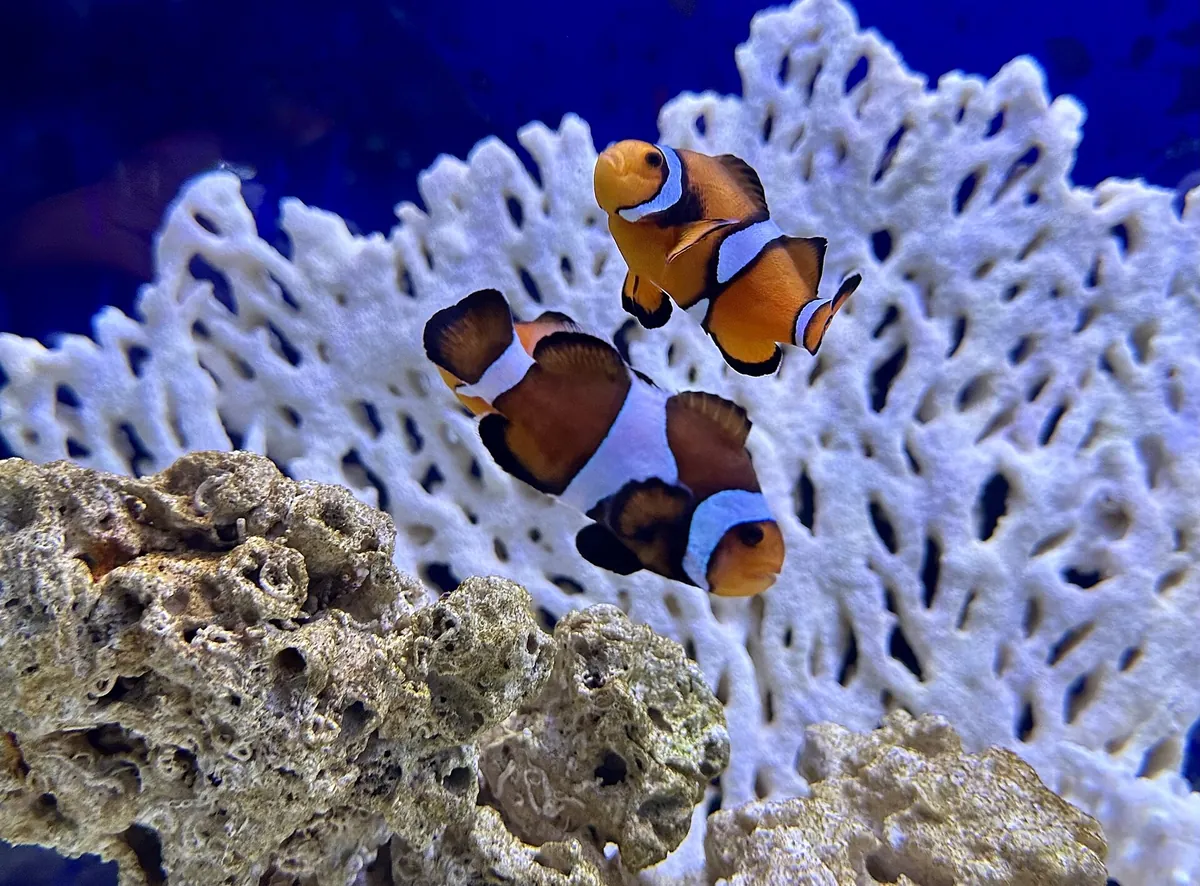
Finding Nemo got clownfish biology wrong, and a wild Marlin would have become the mom. Students watch Raven’s two videos, then work out how DNA from fin clips showed where young clownfish came from.
At a glance
- Middle school
- Grades 6 to 8 · About 23 minutes
- High school
- Grades 9 to 12 · About 38 minutes
- College
- College · About 35 minutes
- Materials
- The worksheet for your level, a screen for the videos.
- Grouping
- Students work alone. For partners, pair students for Questions.
- The phenomenon
- In Finding Nemo, Marlin loses his mate and raises his son, Nemo, in the family anemone. In a wild clownfish group, the breeding male becomes female when the breeding female dies, and the young drift away the night they hatch.
- Topics covered
- Reproduction, eggs, fish that change sex, parental care, DNA tests for parents and offspring, a parent’s death in a movie.
Preview both videos before sharing them with your class.
Videos and transcripts
- 1
Finding Nemo got the clownfish wrong
Explains the size order inside an anemone and why Marlin would have become the mom.
Watch on YouTubeTranscript
Transcribed from the linked cut on YouTube.
Finding Nemo got their biology so wrong that if they had told the truth, the movie would have fell apart in like five minutes. For real.
So clownfish live in these little groups in the sea anemone. You guys remember that word from the movie? Anemone. And the group runs in a strict pecking order. Usually the largest female is at the top of the chain. She’s in charge, and she’s the only one that is breeding as a female.
Right under her is one breeding male, and then under that male are a bunch of other male clownfish that are waiting to breed with the top female. Everybody knows their ring [unclear], and nobody’s moving spots until one opens.
So what happens first thing in Finding Nemo? The mom dies. And this is where Finding Nemo went wrong.
When the dominant female dies, the dominant male assumes the role of the dominant female and literally changes its sex. The dominant male becomes the dominant female and starts producing eggs. So if Finding Nemo was biologically accurate in that opening scene, Marlin would have turned into Marlina. It would have been a mama looking for her baby.
The crazy thing is a lot of that movie was biologically accurate. The currents in the ocean, the different species that were there, the anemone. But the one pivotal thing that changed the entire movie was not biologically accurate.
I’m Dr. Raven Baxter, your favorite scientist, and follow me for more science.
- 2
Nemo is probably not Marlin’s son
Follows the babies into open water and introduces the word larvae.
Watch on YouTubeTranscript
Transcribed from the posted video on YouTube.
Nemo is very likely not Marlin’s son. Finding Nemo only works if the kid is still in the anemone.
In real life, the parents guard and tend the eggs right up to hatching night, and then the larvae, which is what the fish are called as soon as they hatch, they get carried off into open water. Those babies spend about a week and a half in open water, and then they settle into different anemone most of the time. The odds of him ending back up in Marlin’s exact anemone are slim.
Scientists looked at clownfish living on 310 different anemone over 10 years, and they took thousands of little fish fin clips, and they sequenced the DNA, and they used it to build a family tree. And what they found was that when those babies grow up and they settle down, relatives ended up sharing an anemone about two percent of the time.
If there’s a small fish in Marlin’s anemone, it’s very likely not his. Does this change the movie for you guys? Let me know your thoughts in comments below. I’m Dr. Raven Baxter. Follow me for more science. Bye!
Your word of the day is
LAHR-vuh
Larva. A young animal that hatches from an egg and looks far different from the adult it will become.
| Word part | Comes from | Meaning |
|---|---|---|
| larva | Latin larva | ghost, specter, mask |
| prot- (bonus word) | Greek prôtos | first |
| -andry (bonus word) | Greek anḗr (andrós) | man, male |
| philo- (bonus word) | Greek phílos | loving, dear |
| -patry (bonus word) | Latin patria | fatherland, homeland |
Same roots, other subjects
- History and civicsIn ancient Rome, larvae were harmful ghosts. Dictionary.com links the word to the Lares, Roman spirits who watched over a home or a town.
- BiologyA tadpole is the larva of a frog or toad. Butterflies, moths and beetles go through a larva stage too.
- ChemistryA larvicide is a chemical used to kill larvae.
- World languagesSpanish says larva and French says larve.
Word hunt. Ask students to name three animals that go through a larva stage, like a caterpillar or a tadpole, and say how each larva looks different from the adult.
Larva comes from the Latin word for a ghost or a mask. The plural is larvae, the form video 2 uses for newly hatched clownfish. Philopatry, the word in the title of the Salles 2016 paper, is a bonus word on the high school and college sheets. Philopatry means an animal stays near, or comes back to, the place where it was born. Protandry, a bonus word on every sheet, names what Marlin would do. A protandrous fish is male first and can become female later.
Lesson flow
- 3 minPredictStudents answer the question and write one sentence.
- About 3 minVideosPlay video 1, then video 2.
- 4 minWord of the dayBreak the word into its parts together.
- 8 minQuestionsStudents answer on their own, then share out. With partners, pairs discuss first.
- 5 minExit ticket
- 3 minPredictStudents answer the question and write one sentence.
- About 3 minVideosPlay video 1, then video 2.
- 4 minWord of the dayBreak the word into its parts together.
- 8 minQuestionsStudents answer on their own, then share out. With partners, pairs discuss first.
- About 15 minClaim, evidence, reasoning and Going further
- 5 minExit ticket
- About 3 minVideosPlay video 1, then video 2.
- 4 minWord of the dayBreak the word into its parts together.
- 3 minPredict
- 20 minRead the paperThe paper reading works as homework or a discussion section.
- 5 minExit ticket
Worksheet
Predict
In Finding Nemo, Nemo’s mom is lost at the start of the movie, and his dad, Marlin, raises him alone. In a wild clownfish family, could a dad like Marlin become the mom?
Circle one. Yes / No
Watch
- Finding Nemo got the clownfish wrongyoutube.com/shorts/62srRdYYCAg
- Nemo is probably not Marlin’s sonyoutube.com/shorts/5GJUhGE19qA
Word of the day
Larva (LAHR-vuh). A young animal, newly hatched from its egg, that looks far different from the adult it will grow into.
| Word part | Comes from | Meaning |
|---|---|---|
| larva | Latin larva | ghost, mask |
- A tadpole is the larva of a frog.
- The word for more than one larva is larvae. In video 2, Raven calls newly hatched clownfish larvae.
Bonus word. Protandry (pro-TAN-dree). Prot- means “first,” and andr- means “man” or “male.” A protandrous fish is male first and can become female later. The proton in chemistry got its name from the same Greek word for first.
Questions
In a clownfish group, the biggest fish is the mom, called the breeding female. The second biggest is the dad, called the breeding male. The smaller fish wait in line by size. When the breeding female is gone, what happens to the breeding male? What happens to each fish waiting in line?
Hint. Clownfish keep their size order. Start with the biggest fish that’s still alive.
Clownfish parents care for their eggs day and night, and they care the most on the night the eggs hatch. Then the baby fish, called larvae, drift away into open water. How does caring for the eggs help clownfish parents if they don’t raise the babies?
Hint. Think about what could happen to eggs that no parent guards.
Kimbe Island has 310 sea anemones, the stinging sea animals where clownfish make their homes. Of the young fish that moved into these anemones, 56% had hatched from Kimbe Island parents. But family members shared an anemone only about 2% of the time. How can most of Kimbe Island’s young fish come from Kimbe Island parents while family members rarely share an anemone?
Hint. Compare living on the same island with living in the same anemone.
Baby clownfish drift in open water for about 10 days. The Kimbe Island scientists didn’t follow the babies across the water. How did the Kimbe Island scientists figure out which young clownfish belonged to which parents?
Hint. In video 2, Raven says the scientists took thousands of little fin clips. What could scientists test in a fin clip?
Exit ticket
In the movie, Nemo grows up in the same home as his dad, Marlin. What two pieces of evidence say a small fish living with Marlin probably isn’t his son?
Hint. Think about where baby clownfish go the night they hatch. Then think about the Kimbe Island numbers.
Predict
In Finding Nemo, Nemo’s mom is lost at the start of the movie, and his dad, Marlin, raises him alone. In a wild clownfish family, could a dad like Marlin become the mom?
Circle one. Yes / No
Watch
- Finding Nemo got the clownfish wrongyoutube.com/shorts/62srRdYYCAg
- Nemo is probably not Marlin’s sonyoutube.com/shorts/5GJUhGE19qA
Word of the day
Larva (LAHR-vuh). A young animal that hatches from an egg and looks unlike the adult it will become.
| Word part | Comes from | Meaning |
|---|---|---|
| larva | Latin larva | ghost, mask |
- A tadpole is the larva of a frog or toad. Video 2 uses the plural, larvae.
- In ancient Rome, larvae were harmful ghosts.
Bonus words. Protandry (pro-TAN-dree) means male first, from prot-, “first,” and andr-, “male.” Philopatry (fih-LOP-uh-tree), the word in the title of the 2016 Kimbe Island paper by Salles and others, means an animal stays near, or comes back to, the place where it was born. It joins Greek phílos, “loving,” and Latin patria, “homeland.”
Questions
In a study of wild Red Sea clownfish, breeding males carried testis tissue and immature ovary tissue at the same time. After scientists removed the breeding female, the male’s gonad began to change about 24 days later, and the male tissue was gone by day 50. How does a breeding male clownfish become the new breeding female? And what happens to the largest non-breeder and to each smaller clownfish in line?
Hint. The breeding male already carries two kinds of gonad tissue. Which kind matures, and which kind disappears?
Clownfish parents tend their eggs for about a week before hatching. Their care rises as the embryos develop and peaks on hatching night with fanning, mouthing and biting at the anemone, and then the larvae drift away. How could egg care raise the number of offspring that clownfish parents produce? What experiment would test your explanation?
Hint. Compare eggs that get care with eggs that get none. What would you count?
On Kimbe Island, 56% of the young fish that settled had hatched from Kimbe Island parents, and the other 44% arrived as larvae from other reefs. Yet relatives shared an anemone only about 2% of the time. What path does a clownfish larva take from hatching night to settling? And how does that path let most Kimbe Island settlers have Kimbe Island parents while relatives rarely share one of the island’s 310 anemones?
Hint. A larva drifts for about 10 days before it settles. When a larva settles back on Kimbe Island, how many anemones does the island offer?
The Kimbe team never followed a larva across open water. Divers clipped a tiny piece of fin from each fish, and the team read 22 DNA markers from each clip over six rounds of sampling between 2003 and 2013. How can DNA markers link a young fish to one breeding pair? And why would the Kimbe team sample six times instead of once?
Hint. At each marker, a young fish carries one number from each parent. Which fish are alive during any one round of sampling?
Claim, evidence, reasoning
Non-breeding clownfish skip breeding while they wait in line, and the fish around them are usually not their relatives. Answer with a claim, evidence and reasoning on the lines below. Why does a non-breeding clownfish stay in a group instead of leaving for a different anemone?
Hint. Think about what happens when a fish above the non-breeder in line is gone.
Going further: anemone math
Kimbe Island has 310 anemones. Each anemone holds one breeding pair and up to four non-breeders. What’s the most clownfish Kimbe Island could hold at one time?
Circle one. 620 / 1,240 / 1,860 / 2,927
Hint. Find the most fish one anemone can hold first. Then multiply by the number of anemones.
Kimbe Island’s 310 anemones hold a limited number of clownfish at one time. Over ten years, the scientists identified 2,927 different fish. Why could the Kimbe Island scientists identify more clownfish over ten years than Kimbe Island holds at one time?
Hint. Think about how the fish in one anemone change over ten years.
Each Kimbe Island anemone holds one breeding pair, and the island has 310 anemones. What limits how many clownfish can breed on Kimbe Island at once?
Hint. Think about what a non-breeder has to wait for before it can breed.
Exit ticket
In Finding Nemo, Marlin stays a dad after Nemo’s mom is gone, and Nemo grows up in Marlin’s anemone. How do protandry and philopatry each explain a way wild clownfish differ from Marlin and Nemo in Finding Nemo? What evidence backs each word?
Hint. Protandry is about what happens to Marlin. Philopatry is about where Nemo would settle.
Watch
- Finding Nemo got the clownfish wrongyoutube.com/shorts/62srRdYYCAg
- Nemo is probably not Marlin’s sonyoutube.com/shorts/5GJUhGE19qA
Word of the day
Larva (LAHR-vuh). An immature, free-living form of an animal that changes into a different adult form through metamorphosis.
| Word part | Comes from | Meaning |
|---|---|---|
| larva | Latin larva | ghost, specter, mask |
- A tadpole is the larva of a frog or toad. Video 2 uses the plural, larvae.
- In ancient Rome, larvae were harmful ghosts.
Bonus words. Protandry (from prot-, “first,” and andr-, “male”) describes an animal that produces male gametes before female gametes. Philopatry (from Greek phílos, “loving,” and Latin patria, “homeland”), the word in the title of the Salles 2016 paper, describes an animal that stays near, or returns to, its birthplace to breed.
Predict
Océane Salles and the Kimbe Island team put together a family tree of 2,927 clownfish, then counted the parents and offspring living in the same anemone. Make a guess before you read the paper, and write one sentence on why you think so. What percent of parent-and-offspring pairs in the Kimbe Island family tree do you predict shared an anemone?
Hint. In video 2, Raven gives a figure for relatives in general. Would parents and offspring share an anemone more often or less often than relatives in general?
Read the paper
Salles and others, “First genealogy for a wild marine fish population reveals multigenerational philopatry,” PNAS, 2016. The paper is free to read.
Divers on Océane Salles’s team sampled the orange clownfish on Kimbe Island in Papua New Guinea, home to 310 anemones, six times between 2003 and 2013. The team read 22 DNA markers from each fin clip and reconstructed a family tree of 2,927 fish. Table 1 of the paper counts the family links in that tree, then counts the related pairs living in the same anemone.
| Relationship | Family links in the tree | Related pairs in the same anemone | Percent in the same anemone |
|---|---|---|---|
| Parent and offspring | 987 maternal + 987 paternal | 9 | |
| Full siblings | 1,809 | 24, including 1 inbred mating | |
| Maternal half siblings | 412 | 2 | |
| Paternal half siblings | 248 | 5 | |
| Paternal grandparent and grandchild | 278 grandmother + 278 grandfather | 3, including 1 inbred mating | |
| Uncle or aunt and nephew or niece | 308 | 10 | |
| Half uncle or half aunt and nephew or niece | 165 | 2 | |
| Cousins | 218 | 1 | |
| Grand cousins | 17 | 1 |
Quantitative reasoning Fill in the last column of Table 1. For the parent and grandparent rows, add the maternal and paternal links first. Which relationship in Table 1 shared an anemone most often, which percents in Table 1 rest on a single pair, and how much weight should a percent based on a single pair carry?
Hint. Divide the related pairs in the same anemone by the family links in the tree. Watch for rows with a count of 1.
Process of science The Kimbe team used 22 DNA markers, accepted a parent pair only when its LOD score (the log of the odds that the match is true) topped 30, and rejected all matches to a single parent because generations overlap. What mistake does each of the Kimbe team’s three matching rules prevent, and what do strict matching rules cost the counts in Table 1?
Hint. Think about two kinds of error, a false match and a missed match.
Evolution Philopatry can raise the risk of inbreeding, but Table 1 records 2 inbred matings and the paper reports an inbreeding coefficient of 0.018. Self-recruitment averaged 56%, and the other 44% of settlers arrived as larvae from other reefs. How do the inbreeding and self-recruitment numbers and the size order in each anemone explain why inbreeding stayed rare on Kimbe Island, and what would you predict if fewer larvae arrived from other reefs?
Hint. Only the two largest fish in an anemone breed. How likely is a relative to reach the front of an anemone’s breeding line?
Science and society Kimbe Island is a marine reserve. The authors write that a reserve can protect several generations of one population, and they warn that climate change may shorten how far larvae travel between reefs. A reef manager has to decide which reefs to protect. What would you recommend? Write one paragraph that uses at least two numbers from the Kimbe Island paper.
Hint. Think about the birthplaces of Kimbe Island’s settlers.
Exit ticket
Table 1 of the Salles paper counts the family links in the Kimbe Island family tree and the related pairs that shared an anemone. What does Table 1 of the Salles paper show, and what’s one question Table 1 can’t answer?
Hint. Think about what happened to the larvae before they settled.
Standards
The lesson builds toward four Next Generation Science Standards (NGSS), the most widely used US science standards. Some states, like Texas and Virginia, write their own. NGSS covers kindergarten through grade 12. The college worksheet uses the AAAS Vision and Change framework for undergraduate biology.
| Level | Standard | Lesson part | Practice | Crosscutting concept |
|---|---|---|---|---|
| Middle school | MS-LS1-4. Argue from evidence how animal behaviors affect the odds of reproducing (core idea LS1.B) | Middle and high school worksheets, Questions 1 and 2 | Engaging in Argument from Evidence | Cause and Effect |
| Middle school | MS-LS3-2. Model how a baby gets one gene version from each parent (core ideas LS3.A, LS3.B) | Middle and high school worksheets, Questions 4 | Developing and Using Models | Cause and Effect |
| High school | HS-LS2-8. Evaluate evidence for how group behavior affects the odds of surviving and reproducing (core idea LS2.D) | High school worksheet, claim, evidence, reasoning | Engaging in Argument from Evidence | Cause and Effect |
| High school | HS-LS2-1. Use math to explain what limits how many organisms an ecosystem can hold, at different scales (core idea LS2.A) | High school worksheet, Questions 3 and Going further | Using Mathematics and Computational Thinking | Scale, Proportion, and Quantity |
| College | Evolution. AAAS Vision and Change core concept | College worksheet | Core competencies: quantitative reasoning; process of science; science and society | Core concept: systems |
| College | Systems. AAAS Vision and Change core concept | College worksheet | Core competencies: quantitative reasoning; process of science; science and society | Core concept: systems |
Sources
The Kimbe authors call their study “the first multigenerational pedigree for a wild marine fish.” The words wild and marine show students how carefully scientists word a first.
The videos and this lesson draw on several research teams. The lesson credits each team.
| Topic | Who found it | Where it was published |
|---|---|---|
| Kimbe Island in Papua New Guinea, its family tree, relatives sharing an anemone, philopatry | Océane Salles, Benoit Pujol, Serge Planes and seven co-authors, led from the Université de Perpignan Via Domitia in France | PNAS, 2016 |
| Egg care day and night, busiest on hatching night | Madison Pacaro, Tina Barbasch, Michaela Rogers, Juan Chavez, Peter Buston and John Majoris, Boston University | Ethology, 2023 |
| Group members are mostly unrelated | Peter Buston, Steven Bogdanowicz, Alex Wong and Richard Harrison | Molecular Ecology, 2007 |
| Non-breeders wait to inherit the anemone | Peter Buston | Proceedings of the Royal Society B, 2004 |
| Size order, and eviction of fish that mature early | Theresa Rueger, Peter Buston and colleagues at Boston University and James Cook University | Proceedings of the Royal Society B, 2018 |
| Timing of the switch from male to female | Laura Casas, Xabier Irigoien and colleagues at King Abdullah University of Science and Technology in Saudi Arabia | Scientific Reports, 2016 |
| Where the word philopatry comes from | John Pearce | The Auk, 2007 |
The Ethology and Molecular Ecology papers sit behind a paywall. The rest are free to read.
- Research papers, linked in the table above. Paper details for Ethology checked against Boston University’s announcement
- Vision and Change core concepts and competencies, as summarized in Brownell and others, CBE Life Sciences Education, 2014
- Word origins from Dictionary.com: larva, Lares, larvicide, philo-, patri-, proto-, proton, andro-, protandrous
- Philopatry is not in Dictionary.com. Its roots come from John Pearce, “Philopatry: A return to origins”, The Auk, 2007
- Spanish and French spellings from Wiktionary
- Instagram originals of video 1 and video 2, not linked because Instagram needs a login
- NGSS MS-LS1-4, MS-LS3-2, HS-LS2-8, HS-LS2-1