← Coquita the crocodile had a baby with no father
Teacher guide
Coquita the crocodile had a baby with no male, and her baby still wasn’t a clone. Students watch Raven’s two videos and work out why.
At a glance
- Middle school
- Grades 7 to 8 · About 23 minutes
- High school
- Grades 9 to 12 · About 33 minutes
- College
- College · About 35 minutes
- Materials
- The worksheet for your level, a screen for the videos.
- Grouping
- Students work alone. For partners, pair students for Questions.
- The phenomenon
- Coquita, an American crocodile who lived alone for 16 years, laid an egg holding a fully formed baby with no father’s DNA.
- Topics covered
- Reproduction, eggs, sperm, DNA, genetic variation, zoo animals, a stillborn baby animal.
Preview both videos before sharing them with your class.
Videos and transcripts
- 1
Virgin birth in a crocodile, 16 years alone, no male DNA
Introduces Coquita and the word parthenogenesis.
Watch on YouTubeTranscript
Transcribed from the posted video on YouTube.
A crocodile that had not seen another crocodile in 16 years laid an egg, and inside of that egg was a baby crocodile, fully formed. How did that happen?
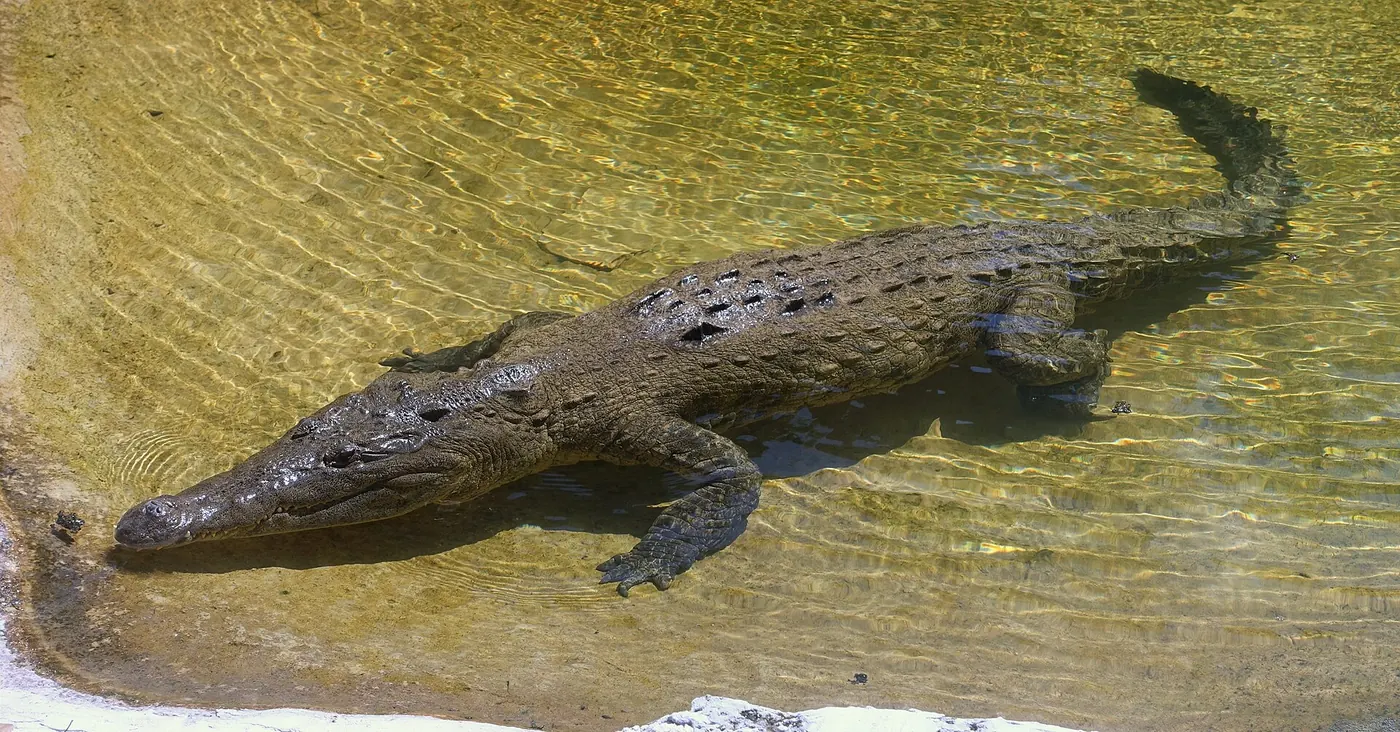
This is a true story, and the crocodile’s name was Coquita, and she lived alone in a Costa Rican park. No male contact for 16 years, and then one day the park staff looked and they saw that she laid eggs. 14 to be exact.
They assumed it was a fluke, but they noticed one of the eggs had a baby in it. Huh? And they’re like, well, this is impossible, because obviously you need sperm in an egg, right, to make a baby.
So they ran a genetic test on this baby crocodile, and the results were insane. The crocodile’s genetics were over 99.9% identical to the mother. The crocodile and the mother had identical DNA. That means that there was no father that contributed to that baby crocodile. The mother made it herself.
This has a name. It’s called parthenogenesis. Everybody say it with me. Parthenogenesis.
And for some animals, this is just how they do it. For example, there are entire species of stick bugs where they’re all female. Each mom just clones itself over and over and over again. Generation after generation, there’s just no males anywhere.
So it kind of makes you wonder, if an animal can clone itself, why did so many of us and other animals evolve to need two parents? Two sets of DNA. And then the whole complicated dance of making love.
But what do I know? I’m just a molecular biologist teaching you guys science. I don’t know. Follow me for more.
- 2
Coquita’s virgin birth is not a clone
Explains why the baby got two matching copies of almost every gene.
Watch on YouTubeTranscript
Transcribed from the posted video on YouTube.
Make a baby with no baby daddy? That’s what Coquita the crocodile did. But Coquita’s baby had no father DNA. How can a baby with no father’s DNA not be a copy of you?
In sexual reproduction, offspring get a blend of DNA from mom and from dad, and the two are different from each other. One half comes from the egg and the other half comes from a sperm.
The egg already has to do a weird move to make that half. It actually splits its DNA in half and pinches off a tiny leftover discard cell. We call it a polar body, that normally just gets tossed. Coquita’s egg kept one half, and then that discard cell carrying her missing half fused back in.
But what happens when that happens? Every spot where she carried one working copy and one broken one, her baby got two of the same. That’s called homozygous. Say it with me. Homozygous. Her baby got two of the same.
And Coquita’s not the only animal that can do this. Two California condors hatched like this and died at one and seven. And we’re still learning all about this.
If you’re wondering what a clone actually is, then you should follow me. I’m Dr. Raven Baxter, your favorite scientist. Follow me for more science. Bye. Homozygous.
Your word of the day is
par-theh-no-JEN-uh-sis
Parthenogenesis. An egg develops into a baby without sperm fertilizing the egg.
| Word part | Comes from | Meaning |
|---|---|---|
| partheno- | Greek parthénos | maiden, virgin |
| -genesis | Greek génesis | origin, birth |
| homo- (bonus word) | Greek | same |
| -zygous (bonus word) | Greek -zygos | joined, as in zygote |
Same roots, other subjects
- History and artThe Parthenon in Athens was dedicated to Athena Parthenos, “Athena the Virgin,” and takes its name from her.
- BiologyDanish geneticist Wilhelm Johannsen coined the word gene in 1909, building on the gen root.
- ChemistryHydrogen comes from Greek roots meaning “water producer,” because hydrogen makes water when it combines with oxygen. Oxygen and nitrogen carry the same -gen ending.
- World languagesSpanish says partenogénesis and French says parthénogenèse.
Word hunt. Ask students to find three more words with gen inside and guess what each one produces or starts.
Lesson flow
- 3 minPredictStudents answer the question and write one sentence.
- About 3 minVideosPlay video 1, then video 2.
- 4 minWord of the dayBreak the word into its parts together.
- 8 minQuestionsStudents answer on their own, then share out. With partners, pairs discuss first.
- 5 minExit ticket
- 3 minPredictStudents answer the question and write one sentence.
- About 3 minVideosPlay video 1, then video 2.
- 4 minWord of the dayBreak the word into its parts together.
- 8 minQuestionsStudents answer on their own, then share out. With partners, pairs discuss first.
- About 10 minClaim, evidence, reasoning
- 5 minExit ticket
- About 3 minVideosPlay video 1, then video 2.
- 4 minWord of the dayBreak the word into its parts together.
- 3 minPredict
- About 20 minRead the paperStudents read Table 1 of the paper and answer the questions. The paper reading works as homework or a discussion section.
- 5 minExit ticket
Video simplifications
- Identical DNA
- “The crocodile’s genetics were over 99.9% identical to the mother. The crocodile and the mother had identical DNA.” Expect students to ask whether that makes Coquita’s baby a clone. Video 2 corrects this line and asks how a baby with no father’s DNA can still not be a copy of its mother. The paper found the baby matched Coquita at more than 99.9% of the spots where Coquita already had two matching copies. At the spots where Coquita had two different copies, the baby kept only about 3% mixed. A clone would keep all of them mixed.
- Which half fused back in
- “Coquita’s egg kept one half, and then that discard cell carrying her missing half fused back in.” The discard cell that fused back in carried a near copy of the same half the egg kept, not Coquita’s other half. Those matching halves explain why the baby got two of the same at almost every spot, as video 2 goes on to say. If the cell had carried her other half, the baby would have kept Coquita’s mix, like a clone. Scientists call this terminal fusion, and the college worksheet covers terminal fusion.
Worksheet
Predict
Coquita the crocodile lived alone at a reptile park in Costa Rica for 16 years. She never met a male. Then she laid 14 eggs. Could one of those eggs have a baby inside?
Circle one. Yes / No
Watch
- Virgin birth in a crocodileyoutube.com/shorts/9Fil5Efiz9o
- Coquita’s virgin birth is not a cloneyoutube.com/shorts/PkigBKfd-oU
Word of the day
Parthenogenesis (par-theh-no-JEN-uh-sis). A baby grows from an egg that was never fertilized, meaning no sperm ever joined the egg.
| Word part | Comes from | Meaning |
|---|---|---|
| partheno- | Greek parthénos | maiden, virgin |
| -genesis | Greek génesis | origin, birth |
- The Parthenon in Athens got its name from Athena Parthenos, “Athena the Virgin.”
- You can spot gen inside gene and genetics too. Gen means birth or origin.
Bonus word from video 2. Homozygous (ho-mo-ZY-gus). Homo- means “same.” Zyg- comes from the Greek word for joined, like in zygote. Homozygous means both copies of a gene match.
Questions
Most babies get half their DNA from mom and half from dad. Coquita’s baby got all of its DNA from Coquita. How was the DNA in Coquita’s baby different from your DNA?
Hint. Most babies get one copy of each gene from mom and one from dad. Who gave Coquita’s baby both copies?
Some female reptiles can store sperm inside their bodies for years. How could scientists prove Coquita’s baby didn’t come from old, stored sperm?
Hint. A baby made with sperm carries some DNA from a dad. What could scientists check in Coquita’s baby?
Coquita’s baby didn’t survive to hatch. What did scientists still learn from Coquita’s baby?
Hint. Coquita’s baby was fully formed. What does a fully formed baby tell you about crocodile eggs?
American crocodiles like Coquita are a vulnerable species, which means they’re at risk of becoming endangered. The scientists who studied Coquita say zoos should test eggs from females that live alone, instead of throwing those eggs away. How could testing eggs from crocodiles that live alone help American crocodiles?
Hint. When a species is in danger, every new baby counts. What could zoos find inside eggs from females that live alone?
Exit ticket
Coquita’s baby had only one parent, and the baby still wasn’t a clone. A mixed pair is two different copies of a gene, like one working copy and one broken copy. How is Coquita’s baby different from a clone?
Hint. A clone is an exact copy of its mom. Did Coquita’s baby keep Coquita’s mixed pairs?
Predict
Coquita the crocodile lived alone at a reptile park in Costa Rica for 16 years. She never met a male. Then she laid 14 eggs. Could one of those eggs have a baby inside?
Circle one. Yes / No
Watch
- Virgin birth in a crocodileyoutube.com/shorts/9Fil5Efiz9o
- Coquita’s virgin birth is not a cloneyoutube.com/shorts/PkigBKfd-oU
Word of the day
Parthenogenesis (par-theh-no-JEN-uh-sis). An egg develops into a baby without sperm fertilizing the egg.
| Word part | Comes from | Meaning |
|---|---|---|
| partheno- | Greek parthénos | maiden, virgin |
| -genesis | Greek génesis | origin, birth |
- The Parthenon in Athens took its name from Athena Parthenos, “Athena the Virgin.”
- You can spot the same gen root in gene and genetics. Gen means birth or origin.
Bonus words. Homozygous (ho-mo-ZY-gus), the word Raven has you say out loud in video 2, means a gene comes as a matching pair, from homo-, “same.” Heterozygous (het-er-oh-ZY-gus) means a mixed pair, from hetero-, “different.”
Questions
Coquita’s baby matched her at more than 99.9% of the spots where she carried two identical copies of a gene. The scientists still say the baby isn’t a clone. How can Coquita’s baby match Coquita at more than 99.9% of her homozygous sites and still not be a clone?
Hint. Look at the spots where Coquita carried two different versions of a gene.
Many female reptiles can store sperm for years. What two pieces of evidence rule out stored sperm as the source of Coquita’s baby?
Hint. One piece comes from Coquita’s life at the park. The other comes from her baby’s DNA.
Coquita’s baby is homozygous at almost every gene, meaning both copies of each gene match. What can happen to Coquita’s baby at a gene where Coquita carries one working copy and one broken copy?
Hint. Coquita’s baby gets one of Coquita’s two copies, twice. List every pair the baby could end up with.
American crocodiles are a vulnerable species, which means they could become endangered. The scientists who studied Coquita say zoos should check eggs from females kept alone, instead of throwing those eggs away. Why would checking eggs from lone females help a vulnerable species like the American crocodile?
Hint. For a species at risk, every egg that could hatch counts. What might zoos be throwing away?
Claim, evidence, reasoning
Coquita’s baby still kept about 3% of Coquita’s mixed pairs. Where did those leftover mixed pairs in Coquita’s baby come from? Make a claim, support your claim with evidence, and give your reasoning.
Hint. Think about what happens to paired chromosomes during meiosis.
Going further
Coquita’s kind of parthenogenesis is called facultative, meaning the animal can reproduce with a mate or without one. Scientists have found it in crocodiles and in birds, the two living branches of the archosaurs. And birds are the only dinosaurs alive today. Could extinct dinosaurs like Tyrannosaurus have reproduced without a mate? Use the crocodile and bird evidence, then name one piece of evidence you’d still need.
Hint. Birds are living dinosaurs, and crocodiles are the closest living relatives of birds. Think about what an ancestor could pass down to both groups.
Exit ticket
Coquita’s baby had one parent, and the scientists still say the baby isn’t a clone. Use the words homozygous and heterozygous. How is Coquita’s baby different from a clone?
Hint. A heterozygous site is a mixed pair. Which one keeps all of mom’s mixed pairs, a clone or Coquita’s baby?
Watch
- Virgin birth in a crocodileyoutube.com/shorts/9Fil5Efiz9o
- Coquita’s virgin birth is not a cloneyoutube.com/shorts/PkigBKfd-oU
Word of the day
Parthenogenesis (par-theh-no-JEN-uh-sis). An egg develops into an embryo without fertilization.
| Word part | Comes from | Meaning |
|---|---|---|
| partheno- | Greek parthénos | maiden, virgin |
| -genesis | Greek génesis | origin, birth |
- The Parthenon in Athens took its name from Athena Parthenos, “Athena the Virgin.”
- You can spot the same gen root in gene and genetics. Gen means birth or origin.
Bonus words. Homozygous (from homo-, “same”) describes a matching pair of alleles. Heterozygous (from hetero-, “different”) describes a mixed pair.
Predict
A heterozygous site is a spot where Coquita carried two different versions of a DNA letter. A clone would keep 100% of those sites mixed. Before you read the paper, make a guess. What percent of Coquita’s heterozygous sites stayed heterozygous in her baby? Write one sentence on why you think so.
Hint. In video 2, Raven says that at every spot where Coquita carried one working copy and one broken copy, her baby got two of the same.
Read the paper
Booth and others, “Discovery of facultative parthenogenesis in a new world crocodile,” Biology Letters, 2023. The paper is free to read.
Warren Booth’s team sequenced the genomes of Coquita and her baby. Table 1 of their paper counts the spots where Coquita carried two different versions of a DNA letter (her heterozygous sites) and how many of those spots stayed mixed in her baby. Each dataset uses sites spaced at least 10,000, 25,000 or 50,000 DNA letters apart.
| Dataset spacing | Coquita’s mixed sites | Still mixed in the baby | Percent still mixed |
|---|---|---|---|
| 10,000 letters | 5,015 | 152 | |
| 25,000 letters | 2,023 | 76 | |
| 50,000 letters | 1,026 | 34 |
Table 1 of the paper gives three datasets, with sites spaced 10,000, 25,000 or 50,000 DNA letters apart. What percent of Coquita’s mixed sites stayed mixed in each dataset, and why would Booth’s team run the same test at three different spacings?
Hint. Fill in the last column of the table first. Then ask what could go wrong if many sites sat close together on a chromosome.
If Coquita’s egg had fused with the first polar body (central fusion), the baby would keep more than 33% of its mother’s mixed sites. If it fused with the second polar body (terminal fusion), it would keep less. Which mechanism do the Table 1 data support?
Circle one. Central fusion / Terminal fusion
Hint. Compare each percent you calculated with 33%.
All of the Table 1 data come from a single baby that grew in one egg. How much should the data from one baby convince scientists about how Coquita’s egg developed?
Hint. Separate two questions. How sure can you be about this one egg, and how sure can you be about crocodiles in general?
Figure 2 of the paper maps the reptile lineages where facultative parthenogenesis has been documented, and the authors connect those lineages to birds. Did facultative parthenogenesis more likely evolve once in an ancestor shared by these reptiles and birds, or several times on its own? What evidence would tell the two apart?
Hint. Think about how biologists decide whether a trait shared by related groups came from a common ancestor.
The authors suggest zoos test eggs from isolated females instead of throwing them away. What should a zoo that cares for a vulnerable species do with eggs from females kept alone? Write your recommendation in one paragraph.
Hint. Think about what those eggs might hold and what the zoo would miss by discarding them.
Exit ticket
Table 1 compares Coquita’s heterozygous sites with the same sites in her baby. What does Table 1 show, and what’s one question Table 1 can’t answer?
Hint. Start with your percents. Then think about what one baby and a count of sites leave out.
Standards
The lesson builds toward three Next Generation Science Standards (NGSS), the most widely used US science standards. Some states, like Texas and Virginia, write their own. NGSS covers kindergarten through grade 12. The college worksheet uses the AAAS Vision and Change framework for undergraduate biology.
| Level | Standard | Lesson part | Practice | Crosscutting concept |
|---|---|---|---|---|
| Middle school | MS-LS3-2. Model why one parent and two parents give different genetic results (core ideas LS3.A, LS3.B) | Middle and high school worksheets, exit ticket | Developing and Using Models | Cause and Effect |
| High school | HS-LS3-2. Make and defend a claim with evidence about where genetic variation comes from, including meiosis (core idea LS3.B) | High school worksheet, claim, evidence, reasoning | Engaging in Argument from Evidence | Cause and Effect |
| High school | HS-LS4-1. Share evidence for common ancestry (core idea LS4.A) | High school worksheet, going further | Obtaining, Evaluating, and Communicating Information | Patterns |
| College | AAAS Vision and Change. Core concepts: information flow, exchange, and storage; evolution | College worksheet | Core competencies: quantitative reasoning; process of science; science and society | Core concept: evolution |
Sources
Warren Booth, an entomologist at Virginia Tech, led the team that tested Coquita’s baby. Their paper, “Discovery of facultative parthenogenesis in a new world crocodile”, appeared in the journal Biology Letters on June 7, 2023. Co-authors came from Kean University, the University of Illinois, the Chiricahua Desert Museum, Georgia State University, Reptilandia Reptile Lagoon in Texas and Parque Reptilandia in Costa Rica, where Coquita laid her eggs. The paper is free to read.
The authors call this the first evidence of parthenogenesis in a crocodile “to our knowledge.” That phrase shows students how careful scientists word a first.
- Booth and others, Biology Letters, 2023
- Card and others, Scientific Reports, 2021 (king cobra)
- Vision and Change core concepts and competencies, as summarized in Brownell and others, CBE Life Sciences Education, 2014
- Word origins from Dictionary.com: parthenogenesis, homozygous, gene, hydrogen
- Mark Cartwright, “Parthenon,” World History Encyclopedia
- Spanish and French spellings from Wiktionary
- NGSS MS-LS3-2, HS-LS3-2, HS-LS4-1