Teacher guide
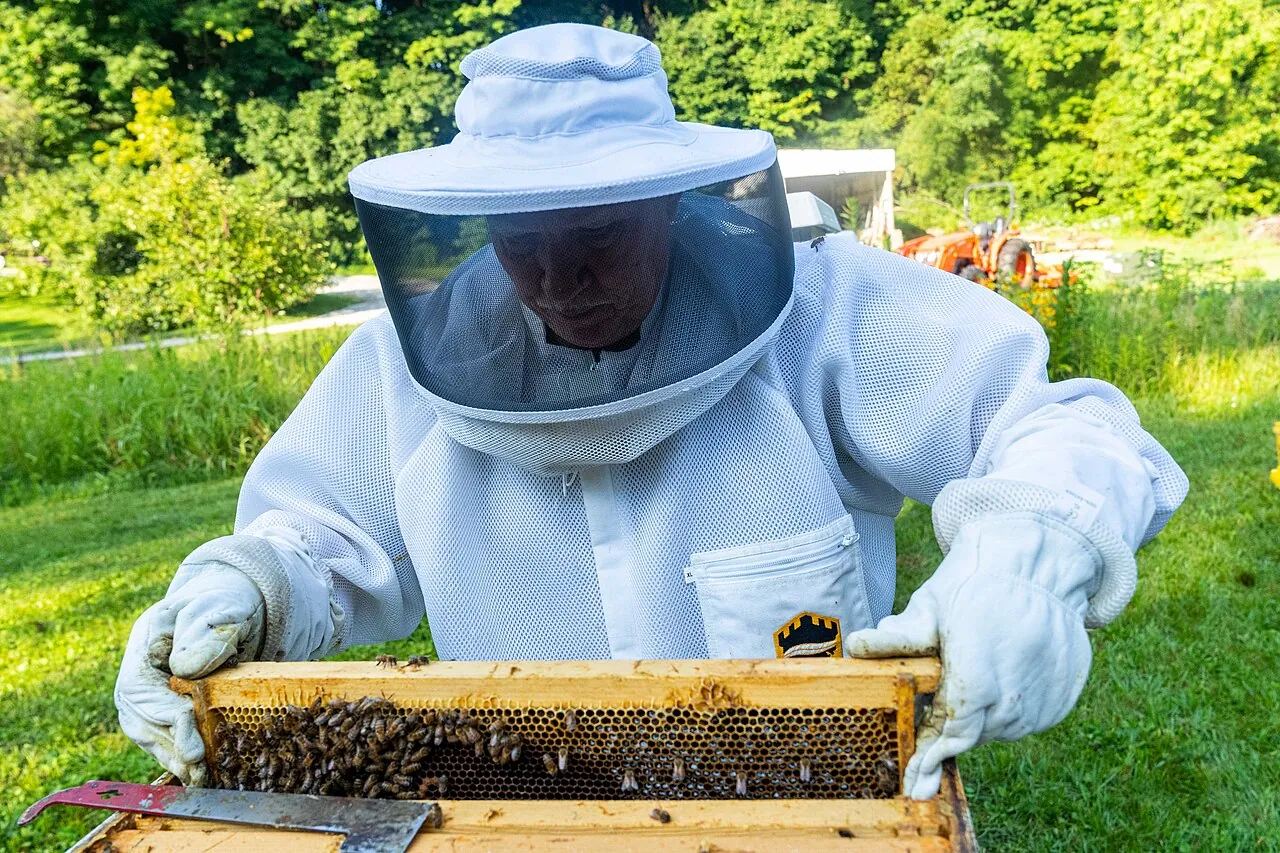
Raven and her co-host, entomologist Annika Salzberg, spend a day as beekeepers with the Werner family at Bee Country, a family bee farm in western New York. Students see how a colony works, from a queen who lays 1,000 to 1,500 eggs a day to workers who switch jobs as the colony needs, and how bees turn nectar into honey and honey into wax. The lesson closes on how people can help honey bees and New York’s 400-plus species of native bees. College students check the episode’s line that bees are “responsible for a third of our food” against a review of world crops.
At a glance
- Middle school
- Grades 6 to 8 · About 50 minutes
- High school
- Grades 9 to 12 · About 63 minutes · A calculator
- College
- College · About 60 minutes · A calculator
- Materials
- The worksheet for your level, a screen for the episode, a calculator for the high school and college worksheets.
- Grouping
- Students work alone. For partners, pair students for Questions.
- Phenomenon
- A beginner’s nuc of 5,000 to 7,000 bees grows into a colony of about 60,000. The queen lays 1,000 to 1,500 eggs a day, yet by late summer the colony stops growing, because as many bees die each day as she makes.
- Topics
- Bees and beekeeping, the queen and worker jobs, how a colony grows, honey and beeswax, sugar syrup sold as honey, native bees, careers in farming. The college worksheet adds crop pollination.
Preview the full episode before sharing it with your class.
Video and transcripts
- 1
I WAS A BEEKEEPER for a day!
Nerdy Jobs season 1, episode 2, 22:36, unlisted. Raven and her co-host, Annika Salzberg, spend a day with the Werner family at Bee Country in Darien Center, New York.
Watch on YouTubeTranscript
Transcribed from the posted video on YouTube.
The striking purple of prairie asters and the bright orange flowers of marigolds along a roadside or in a field.
Oh my god.
I’m excited. I’m nervous, but I’m excited. Hello, everybody. Thank you for joining us for another episode of Nerdy Jobs. I’m here at Bee Country with the Werners.
Hello, everybody.
Thanks for having us here at your farm.
Thanks for coming.
With my co-host Annika, and we’re here to learn about bees. So what’s there to know about bees?
First of all, they’re responsible for a third of our food. They’re extremely important. We need to protect them, and that’s how we got started. We tried to save the bees.
And when we got, when we got our first hive, we bought our first hive, the guy literally handed it to us, and he was, we understand now, he was so busy that he just handed it to us and went back to work. Really had no idea what we were doing. So when, when Mike got involved, we decided we were going to be there for, for people to help them when they get started, and that’s where the nucleus colonies come in.
And I was just going to have maybe 50 hives until my son got involved, and now we have between five and seven hundred hives. And there’s, there’s, there’s really a lot of people that have taken up to it, and then they love having a hive or two in the backyard. So that’s where pretty much our business has turned into that, where we’re really trying to gear ourselves towards helping beginner beekeepers.
So I heard you say nucleus colony, and I’m a molecular biologist, so we study cells and everything in it, and I know the nucleus is where the DNA is. It’s like where they, all the instructions are for the cell. What’s a nucleus colony as it pertains to beekeeping?
It’s a mini complete hive. It has everything that bees need to expand, and, um, basically it’s a little easier to transport. So that’s how you start people, as you give these, these nucleus colonies to, um, beginners to take home and put in their backyards and start beekeeping in that. It’ll have the queen, the brood, honey, empty frame, just, just everything they need. You know, they don’t have to go and buy a queen and put it in and hope for the best. It’s all set to go.
A nucleus colony will probably only have maybe five thousand to seven thousand bees in it, which right now the colonies are in the range of sixty thousand bees.
So where do the other bees come from? Are they born from the hive, or do other bees from other hives migrate to the nucleus colony and then they start being friends?
That’s where the queen comes in. She’s why, she’s so important to a colony. She’s laying anywhere from like a thousand eggs to 1,500 eggs a day. And right now it’s, it’s so vital because once they start foraging, they only live two weeks. So it’s a, it’s a turnover. Right now there’s just as many bees dying as she’s making. In the springtime, it’s all a build-up thing.
Okay.
She makes more than, than actually die.
So what are these different jobs? What do they mean? Nurse bees, housekeeping bees?
When they’re first born, that’s nurse bees. Um, they actually, they take care of all the other bees, and, and they basically feed the really young ones. And then there’s actually certain ones that just feed the queen. Doesn’t feed herself. She actually gets fed.
You might, uh, then protect the hive, or you might just start foraging. It actually depends on what the colony needs. Um, if they need food, then everybody converts to foragers, and, uh, even, even, um, they’ll do it a little quicker than usual, and they’ll have like three weeks of flying. But, uh, most of the time that flying is actually what kills them. They literally fly themselves to death making so many trips, because it takes like, they got to visit like a million flowers to make a teaspoon of honey.
Oh.
So I have a question for you, my special co-host. Um, so we just learned that bees can adapt new behaviors based on the needs of a colony, and I want to know, how do they adapt these behaviors? Is it through chemical signaling by pheromones? Is it instinctual? What’s going on there?
Yeah, so it’s probably a combination of a lot of those things. Bees are constantly communicating with each other. They’re dancing at each other to tell each other what’s going on. But in the case of when do we all decide to become foragers, I would believe it would be like, we just recognize there’s not enough food, it’s getting late, it’s starting to get cold.
And so surviving that long in a hive, months and months, they’re eating honey. But I’ve heard that honey is bee vomit. Is that true, or is that false?
That’s not, not necessarily. Bees actually have two stomachs. They don’t have, um, they have a way of transporting and they have a way of ingesting. And that’s actually what the foragers do is, uh, they put it in that, basically, travel stomach, and then when they actually get back to the hive, they will pretty much regurgitate that, I guess, towards the, to the next bee who’s right at the entrance waiting for it, rather than that bee then having to go all the way up in the hive and then come back out.
It’s all, it’s always efficiency with bees. So if they can be efficient and just pass it off to the next bee and then go back out and forage more, um, it then, it works a little bit better.
Once it’s honey, so the whole process through, they haven’t vomited any honey?
Yeah, it’s all the nectar area [unclear], and when it gets to the nectar and they dry the nectar and, and cap it, then it’s honey.
Yeah. Can we talk about these bee products that you have?
Sure. These are a little bit more specialized, but we actually do, mostly in Bee Country, we basically supply other people that like to do this stuff. Um, we don’t make these candles, but we, we make a ton of bees, beeswax, which we sell. Um, if, that’s the most specialized product we do have is the comb. Um, that is one that, it takes us a long time to get that perfect, because a consumer won’t buy a 90 percent done piece of comb. They want it 100% done.
So we do sell a lot of honey in the jars like that, um, locally. Pretty much become more suppliers for other, um, places. Like a lot of people, they make mead. It’s like a honey wine. Um, we got several around here, and they think use a lot of our honey for that.
Wow. Can’t believe how much we learned about these. Let’s get buzzing out by the hives.
Okay. All right, well, we’re at the apiary, and, uh, clearly we’re about to get into some missed behavior [unclear].
Okay, so basically, as soon as you come out here, you might want to make sure you get your smoker going. Um, this is what, uh, pretty much tricks the bees into thinking there’s a wild, um, fire. That’s kind of a trick of beekeeping. Um, pretty much everybody knows that, but they don’t really know why. So you just kind of take the smoker and you smoke the front of it a little bit, make sure that all the guard bees go into the hive and start consuming resources.
The structure of the hive, so it’s basically, I like to almost visualize from the outside, the bees always surround themselves with the honey and nectar and pollen. They’ll store it right in the cells, and then the brood will always be right in the middle. And that’s basically because they always want to keep it warm. They’re feeding the baby bees, and everything is really nice and tight in there, and that’s kind of, uh, just the way they do it.
So that’s how you actually start inspecting your hives, is you start with the outside frame, because you don’t want to damage any, any of those baby bees and, or any of the, um, the brood that might be in there.
And it’s actually, you can see all that shiny stuff. That’s nice brand new nectar that they’re getting from, um, especially right now is goldenrod bloom. So that’s, that’s some of their stores for this winter. They’re going to need a lot more than this, but, uh, it’s a start.
So how many bees do you think are, are on that, um, tray?
Um, yeah, this is a, this is a frame. Um, there’s really not that many bees on there. Um, it gets way worse than this. Sometimes you’ll have it where they, they are covering the entire thing, and that’s where you would be getting up into like maybe the, the 2,000 range. And, uh, because there’s not much to look at there, we just gave them this box a little bit ago, we’re just going to go right into this box to show you some other stuff.
And you can kind of notice that you probably have this different idea in your head of how looking through a beehive would be. You thought probably that they would be bouncing off you like they are.
Oh my god. Okay. Uh-huh.
But, uh, they kind of just, they’re still protecting, but they’re not, they’re not really aggressive. It’s more curiosity. And that’s when they start poking up like that, their little, their little heads starting to come up. That’s where you know you got to use a little bit more smoke. This is really your biggest tool as a beekeeper, is using that smoke, because you don’t want to let them get too upset.
Pretty terrified. Okay. How many times have you both been stung?
Um, we get stung on a daily basis. Um, it’s basically a numbers thing. We look at so many bees. And you can see like how there’s that many bees covering this frame now. Now this is a, a little bit better interpretation of what a hive should be looking like it this time. Um, there’s basically just bees everywhere. And actually, if you look in here, all that cappings there, there’s actually baby bees under there.
So what’s the process of looking for the queen? Like, you’re, I see you’re searching through the frame. Is there any characteristics of the behavior?
The behavior there is, she’s a little bit bigger. Um, she gets mistaken a lot for the male honeybee, which is a little bit bigger as well. But the, the biggest thing is she looks just like a honeybee, and basically her, her abdomen is just longer. That’s our queen right there. She’s got a lovely white dot on her.
That’s actually a really cool frame, because you can see this side, they’re working it very nicely. And if you actually flip that over...
Oh, Jesus. Okay.
They’ll figure it out. But, uh, see this side? See how there’s no bees, no nectar, no, no anything? That’s, that’s basically what it would look like if the bees weren’t taking care of it and weren’t using it.
Thanks for showing us the nucs. I guess now let’s check out what the nucs grow into. I’m terrified.
All right, so you’re feeling a little bit of anxiety of being around...
Just a little bit. You know, just a little bit.
So it’s totally understandable. Humans, we’re programmed to be scared of things that can hurt us. No one’s taught, like, what does an angry bee look like versus just a bee, because they’re always buzzing.
Yeah, making noises.
But the more time you spend around insects, the more you start to learn about them, the more comfortable and familiar you get with those behaviors that you have to look out for. Maybe it’s all about just paying a little closer attention, like getting over a little bit of that fear to look closer at the bug in front of you and think, okay, maybe I can start to recognize, like, what does a beehive sound like when it’s pissed off, versus, oh, that’s just like a noise. That’s just the noise they’re making.
Yeah, like, like a cat is purring, a beehive’s just buzzing around. Okay, well, maybe I won’t be so afraid next time we get to the hive. Thanks, Annika. I think I’m ready to take on the hive. Let’s do it.
So we’re gonna go quickly through these first three, but as you can see, and normally we wouldn’t even take this top inner cover off, I was going to show a little bit of just for the camera the difference here of resources. What we just showed you, you’re going to see that this hive is full of beans [unclear] right from bottom to top.
And then, uh...
It’s so sticky.
It is, it’s very...
It’s so different from the last, the nucs.
Wow. Now this is because it’s up out of, like, their brood nest is now down here, where I was showing you before. It, the honey always surrounds the brood. This is so big that all the honey is up above the brood nest, and so you can see all the honey there. And you can even see through the cappings here, you can see different colors of honey.
So this was, they always start kind of up and out, so this was older honey. This is probably a month ago’s honey, and then this darker stuff is what is happening right now, which is probably goldenrod. Um, so, and it’s always hard to tell. I hate putting a label on honey because it takes, I think it’s two million flowers to make a teaspoon of honey.
So will honey from different types of flowers taste different?
Yes. Yeah, it’s, it looks different, it tastes different. Um, what we’ve had on the jars on the table is our most common honey that we get and most in demand. People really love the light colored honey. It’s kind of a little bit like maple syrup. Everybody wants to light maple syrup. Um, we actually prefer the dark stuff because the dark has more flavor to it. Um, pretty much the darker it is, probably the more pollen and stuff like that it has in it.
Um, one of the really cool ones that we make is buckwheat honey, and it is black. You can’t even, you hold it up to the light, you can’t even see through it, compared to that stuff, was really light. Um, and they’re actually doing tests on that, and they actually found that buckwheat is better for you than the manuka honey that everybody pays like a ridiculous amount of money for.
Now he’s, uh, kind of down into the brood nest here.
Yeah, I would say this is actually a lot of honey by the weight of this. I say actually just take, take you love there [unclear] and feel the weight of this. It’s going to be heavy.
Oh, wow. No, that’s really heavy. So what is the, what are the actual honeycomb structures made of? That’s also honey, or is it a different...
That’s actually beeswax.
It’s beeswax.
This is where, see here, this is, this we call burr comb, because it’s not where they normally put it. It’s all wax. And because it’s darker like that, that’s actually recycled wax. They’ve taken it from something else and, and put it in between these, these frames.
Wow. Okay.
See how nice, nice and light? Oh, that’s like brand new wax. Okay. Something they just produced, um, recently.
So where does the wax come from? Like, it’s all coming from...
It’s not coming from the flowers. It’s coming from actually in, in the long terms, yes, because they actually consume, I think it’s like eight pounds of honey to produce a pound of wax. So when they actually ingest the honey, and actually now, now it’s the other stomach where they’re actually eating it, um, then they’ll actually produce wax, and it comes out of a wax gland in the back of their legs, which is kind of weird. But yeah, they’ll produce that, and then they’ll actually start making those hexagon shapes that all the honey and the pollen and the bees and everything is stored in, those little containers.
Oh my goodness. So this eventually, if you get enough of it, would be a candle, or could be a candle?
Yeah.
Where do you, how do you spin? It’s like a salad spinner?
Um, it’s not a bad, it’s not a bad, uh, idea. Basically it’s, yeah, it’s a centrifuge. It just, you load them up there, and it’s like a washing machine. You just turn it up, and it spins it so fast that actually all these, all this honey will be stored in there, but these cells are slightly sloped this way. So when you put the frames in there and you spin them really fast, they’ll keep flying out, and then it’ll hit the outside of our spinner and then run down, and we then, we pump it into a barrel.
Wow.
And then this is all capped, and what we do is we just take these cappings off like that.
Whoa.
Yeah, that’s, that’s what everybody’s used to, is just the honey, and we spin it.
It breaks so easily.
It does. It’s very fragile.
Wow.
But they’ll, they’ll be able to fix that. They’ll fix that in literally like an hour.
What? They can fix that?
Because they don’t want to lose, they put so much time and effort into that honey that they’ll fix that. They’ll be like, top priority when he puts it back in there.
You know, beekeepers get this rap for essentially stealing too much for them, or, or basically just trying to suck what they can off these bees. What we actually do in our jobs are, are literally going down through and seeing if we can help these bees in any way do what they naturally do. This is what they want to naturally do. They want to make a ridiculous amount of honey, more than they could ever possibly need.
Pretty much we let bees be bees. They’re very good, they go to what they do. Um, trying to manipulate them and get them to do what people want them to do is not so easy, and you kind of can’t really tell an insect what to do, and they don’t really follow instructions very well.
Well, I had a question about, uh, bee products. And you all sell, like, pure raw honey from your hives, but what about what’s on the shelves at the grocery stores?
Um, it’s actually a big problem that, um, America has, is actually importing Chinese honey. It’s not really honey. It’s actually rice syrup a lot of times. Um, and they’ll, they’ll bring it in and they’ll sell it in big chain stores and stuff like that. So the people are buying that little bear, the little squeeze bear that everybody thinks of as honey, probably 90% of the time that, that is not pure honey. That is, that has probably been cut with something, and or maybe it’s a more of a syrup than it is honey.
So what about the honey jars that it says it’s like from Brazil slash USA slash, like, of many other countries? How can one jar of honey be from so many places?
That is basically because they buy it from multiple, they buy it as cheap as they possibly can, and then they dump it in this giant thing, and then they bottle it. And so they have no way of telling which, where it actually came from.
So you study bugs, right? So not specifically bees, but bugs. And bugs pollinate, right?
Yeah, tons of insects pollinate. So honey bees, huge pollinators, but they’re not actually native to the U.S. And we have a ton of different bee species in the contiguous U.S. In New York State, we have over 400 species of native bees.
And so when we talk about saving the bees, we can talk about helping out your local beekeeper by buying honey local. We can talk about planting wildflowers, and anything you do that’s like that will also help your native bees. So just don’t mow your back lawn, or don’t mow a strip of it. Leave a bunch of wildflowers out. The honey bees will thank you, the native bees will thank you, and all of the other pollinators that do a lot of stuff that we don’t even sometimes think of as pollinators.
And by keeping all of your native biodiversity, from flowers, other plants, you’re helping all biodiversity. More different types of plants, more different types of bees, helping your honey bees as well. You just have a healthier ecosystem.
I love this. Great notes from Annika, our resident entomologist. Thank you, Annika.
Sure thing.
Okay, well, thanks, Mike, for having us at the Bee Country Honeybee Farm. We learned so much today, right, Annika?
Yeah, we learned about, um, hive upkeep, about nucs, about different kinds of honey.
So much to learn. Yeah, how to maintain hives, all the different types of honey, and it was incredible. I feel like we learned so much, but we also barely scratched the surface, right?
Yeah, yeah. We’ve been doing it for about 15 years, and we’re, we feel like we’ve just, uh, scratching the surface too. We learn, we learn something new every day.
It’s a nerdy job.
It is, but it’s not a job when you love it. Yeah, it’s, it’s interesting. Um, I think that’s why it makes it a unique sort of thing, and that’s why a lot of people just don’t know about it too. So it’s, uh, it’s really nice that you guys came out and, uh, you got to spotlight this a little bit for us.
So thanks for having us. And where can we learn more about Bee Country Honeybee Farm?
Yeah, you can go to, um, beecountry.net, and we have a lot of different stuff on there, all of our products, and, um, pretty much anything we’re involved in is on that website, and it’s a pretty good spot to start.
Awesome. We’ll definitely check that out. And you can follow Nerdy Jobs to see what other jobs we get into, all the science shenanigans on the way. Uh, follow us on social media, and we’ll see you next time.
No, I know what APCs [unclear] do. I know them. We’ll see. People are gonna be grossed out that I don’t have socks on, so don’t record this part.
Your word of the day is
AY-pee-er-ee
Apiary. A place where bees are kept in hives.
| Word part | Comes from | Meaning |
|---|---|---|
| api- | Latin apis | bee |
| -ary | Latin -ārium | a place for |
| nucleus (bonus word) | Latin nucleus | kernel, from nux, nut |
| mel- (from the honey bee’s scientific name) | Latin mel | honey |
Same roots, other subjects
- History and artA library and an apiary share the same Latin ending. Library comes from Latin librārius, “of books,” from liber, book.
- BiologyThe western honey bee’s scientific name is Apis mellifera. Apis means bee, and mellifer means “honey-bearing,” from mel, honey.
- ChemistryA binary compound, like sodium chloride, holds only two elements. Binary comes from Late Latin bīnārius and carries the same -ary ending.
- MathBinary numbers use only two digits, 0 and 1. Each place in a binary number stands for a power of 2.
- MusicA mellifluous voice sounds sweet and smooth. The word comes from Latin mel, honey, and fluere, to flow.
- World languagesSpanish abeja and French abeille both come from Latin apicula, “little bee,” a small form of apis.
Word hunt. Ask students to find three more words that end in -ary or -arium and say what each one is a place for.
The worksheets carry a short version. Use these for discussion or a word hunt. An apiarist (AY-pee-uh-rist) is a beekeeper. Nucleus, the bonus word, is Latin for kernel, a shortened form of nuculeus, from nux, nut. In the episode, Raven says she is a molecular biologist and knows the nucleus as the part of a cell that holds the DNA. The beekeepers explain that a nucleus colony, or nuc, is a “mini complete hive” with a queen, brood and honey.
Lesson flow
- 3 minPredictStudents answer the question and write one sentence.
- About 30 minEpisode with pause pointsPlay the 22-minute episode and stop at each pause point below to ask its question aloud. With partners, pairs talk before the class shares.
- 4 minWord of the dayBreak the word into its parts together.
- 8 minQuestionsStudents answer on their own, then share out. With partners, pairs discuss first.
- 5 minExit ticket
- 3 minPredictStudents answer the question and write one sentence.
- About 30 minEpisode with pause pointsPlay the 22-minute episode and stop at each pause point below to ask its question aloud. With partners, pairs talk before the class shares.
- 4 minWord of the dayBreak the word into its parts together.
- 8 minQuestionsStudents answer on their own, then share out. With partners, pairs discuss first.
- About 13 minClaim, evidence, reasoning and Going furtherStudents list evidence from the episode for the wildflower claim, then write the reasoning. Going further works with European Union honey fraud data.
- 5 minExit ticket
- About 30 minEpisode with pause pointsPlay the 22-minute episode and stop at each pause point below to ask its question aloud. With partners, pairs talk before the class shares.
- 4 minWord of the dayBreak the word into its parts together.
- 3 minPredict
- About 18 minRead the paperStudents read the abstract numbers and Figure 3 of the paper, then check the episode’s “a third of our food” line. The paper reading works as homework or a discussion section.
- 5 minExit ticket
Pause points
Stop the episode at each point below and ask the question aloud. The answers stay oral. The worksheets carry no pause questions.
| Scene | Question | Answer |
|---|---|---|
| Raven introduces her co-host, Annika Salzberg | Who is Annika, and what does Annika bring to the day? | Raven calls Annika the group’s resident entomologist, a scientist who studies insects. Annika explains how bees communicate, how to feel less afraid around bees and how to help native bees. |
| The beekeepers explain nucleus colonies, or nucs | What is a nuc, and how does a nuc grow into a full colony? | A nuc is a “mini complete hive” with a queen, brood, honey and an empty frame, about 5,000 to 7,000 bees. The queen lays 1,000 to 1,500 eggs a day, and a full colony holds about 60,000 bees. |
| The episode explains how bees make honey | How does flower nectar become honey? | Foragers carry nectar home in a separate travel stomach and pass the nectar bee to bee. The bees dry the nectar, add enzymes and cap ripe honey with wax. This stop answers the opening question. Raven asks whether honey is bee vomit, and the beekeeper’s answer is no, because the nectar rides in the travel stomach, apart from the stomach bees eat with. Nicolson’s team calls the travel stomach the crop and describes bees bringing nectar droplets back up onto the tongue to dry them. Students who answered yes have something to point to. The beekeeper’s point is that the nectar never went into the stomach bees eat with. |
| The group walks out to the hives, and Raven says, “We’re at the apiary” | What is an apiary, and who lives in an apiary? | A place where bees are kept in hives. The word of the day comes back after the episode. |
| The first look inside a hive | Where in the hive do bees keep honey, and where do young bees grow? | The bees store honey, nectar and pollen around the outside and keep the brood in the middle, where it stays warm. Beekeepers start an inspection at an outside frame so they don’t hurt the brood, and they use smoke to keep the bees from getting upset. |
| Annika talks about being afraid of bees | How can paying close attention help a person feel less afraid of bees? | Annika says the more time people spend around insects, the more they learn which behaviors to watch for, like the sound of an upset hive versus normal buzzing. The beekeeper adds that bees poking their heads up are curious, not aggressive. |
| The beekeeper explains where beeswax comes from | Where does beeswax come from, and what does wax cost the bees? | Bees eat honey, make wax in wax glands and shape the wax into six-sided cells. The beekeeper estimates 8 pounds of honey for each pound of wax, the same figure a University of Nebraska beekeeping guide gives. The beekeeper places the wax glands on the legs. Wax glands sit on the underside of the abdomen. |
| The episode talks about syrup sold as honey | What is fake honey, and who loses money when people buy fake honey? | Honey stretched with cheap sugar syrup. Beekeepers lose sales to cheaper jars, and shoppers pay honey prices for syrup. |
| The episode counts the kinds of bees in New York State | How many kinds of bees live in New York State, and are they all honey bees? | Annika says New York State has over 400 species of native bees. Honey bees aren’t native to the US. Those native bees are wild bees, like bumble bees. |
| Annika talks about saving the bees | What can people do to help honey bees and native bees? | Annika names three things. Buy honey from local beekeepers, plant wildflowers and leave a strip of lawn unmowed. She says more kinds of plants support more kinds of bees and a healthier ecosystem. All of Bee Country’s honey is produced and processed in New York State. |
Video simplifications
- The farm’s location
- The shooting script puts Bee Country “in Rochester, NY.” Bee Country’s address is in Darien Center, and its site describes the farm as near the Buffalo and Rochester area.
- Hive count
- In the episode, a Bee Country beekeeper says the farm now keeps “between five and seven hundred hives.” Bee Country’s site gives no hive count, so the episode is the source for this number.
- Where wax comes from
- The beekeeper says wax “comes out of a wax gland in the back of their legs.” Wax glands are on the underside of the worker bee’s abdomen, not on the legs. Correct the detail if students repeat the line.
- Flowers per teaspoon
- The episode gives two numbers for the flowers behind one teaspoon of honey. Early on, a beekeeper says bees “got to visit like a million flowers to make a teaspoon of honey.” Later, at the big hive, the beekeeper says “two million flowers.” Students may notice the mismatch. The lesson has no source for either number.
- How long workers live
- The beekeeper says foragers “only live two weeks” once they start foraging. MAAREC says workers do jobs inside the hive “during their initial few weeks as adults,” then forage, and that “the life span of the worker during summer is about 6 weeks.” The two numbers fit together. Workers reared in the fall may live as long as 6 months.
- Honey for wax
- The beekeeper says, “I think it’s like eight pounds of honey to produce a pound of wax.” A 2025 Nebraska Extension guide from the University of Nebraska–Lincoln says honey bees need “approximately 8 pounds of honey to produce 1 pound of beeswax.” A 2012 University of Wisconsin-Extension sheet gives a range, “about 6-8 pounds.” The high school exit ticket credits the 8-to-1 figure to the beekeeper and the Nebraska guide.
- “A third of our food”
- A Bee Country beekeeper opens the episode saying bees are “responsible for a third of our food.” Klein’s review found that 35% of global food production by volume comes from crops that depend on animal pollinators to any degree, and the authors note that the production directly attributable to animals is lower. Those pollinators include wild bees and other insects as well as honey bees. The college worksheet checks the line. The middle and high school worksheets leave crop pollination out.
- The honey bee’s name
- The research notes spell the honey bee “apis melliflora.” The scientific name is Apis mellifera.
- Moving bees
- The shooting script planned questions about bees trucked from California to Florida for pollination. Bee Country says none of its own bees are used for crop pollination or moved south.
- Pronunciation
- Apiary is AY-pee-er-ee. Apiarist is AY-pee-uh-rist. Nucleus is NOO-klee-us.
Worksheet
Predict
Honey bees make honey from nectar, the sugary water inside flowers. Each honey bee carries nectar home inside her body. Is honey a kind of bee vomit?
Circle one. Yes / No
Watch
- I WAS A BEEKEEPER for a day!youtu.be/hAVklEerZFI
Meet the scientist
The beekeepers at Bee Country
Job. Beekeeper. Another word for a beekeeper is apiarist (AY-pee-uh-rist).
A workday. Bee Country is a family bee farm in Darien Center, New York. The beekeepers there raise their own queen bees and collect honey. They also build small starter hives to sell. Each starter hive holds two frames of honey and pollen and three frames of growing baby bees.
Training. Beekeepers learn by working with bees and by taking classes. Cornell University has a beginner program for people with 0 to 2 years of beekeeping. Its Master Beekeeping Program asks for at least 3 years first.
Word of the day
Apiary (AY-pee-er-ee). A place where bees are kept in hives.
| Word part | Comes from | Meaning |
|---|---|---|
| api- | Latin apis | bee |
| -ary | Latin -ārium | a place for |
- A library is a place for books, and library ends in the same -ary.
- Spanish abeja and French abeille both mean bee. Both words come from Latin apis.
Bonus word. Nucleus (NOO-klee-us). Nucleus is the Latin word for kernel, the part inside a nut. In a cell, the nucleus holds the DNA, the meaning Raven knows as a molecular biologist. In beekeeping, a nucleus colony, or nuc, is a small starter hive with everything it needs to grow.
Questions
Flower nectar is sugary water. Honey is much thicker and sweeter than nectar. How do honey bees turn flower nectar into honey?
Hint. What do the bees take out of the nectar? What do they add?
Worker bees change jobs. In the episode, a Bee Country beekeeper says young workers start as nurse bees that feed the baby bees. Later, a worker might guard the hive or fly out for food. The job depends on what the colony needs. What do worker bees do when the colony runs short of food?
Hint. Which bees bring food into the hive?
Some honey sold in stores has cheap sugar syrup mixed in. The label still says honey. How does honey mixed with syrup hurt beekeepers like the Werner family?
Hint. Syrup costs much less than honey. Which jar would a shopper pick to save money?
In the episode, a Bee Country beekeeper says the bees are making new honey from goldenrod flowers. The farm also makes buckwheat honey, so dark it looks black. Why would planting more flowers help honey bees and wild bees?
Hint. What do bees eat?
Exit ticket
In the episode, a Bee Country beekeeper walks through how bees arrange a hive. The brood, or baby bees, sits in the middle. The bees store honey, nectar and pollen in the cells all around the brood. Why do honey bees keep the brood in the middle of the hive? And why does a beekeeper start looking through a hive at an outside frame?
Hint. What do baby bees need? Where are they easiest to hurt?
Predict
Honey bees make honey from nectar, the sugary water inside flowers. Each honey bee carries nectar home inside her body. Is honey a kind of bee vomit?
Circle one. Yes / No
Watch
- I WAS A BEEKEEPER for a day!youtu.be/hAVklEerZFI
Meet the scientist
The beekeepers at Bee Country
Job. Beekeeper, also called an apiarist (AY-pee-uh-rist).
A workday. Bee Country is a family-owned bee farm in Darien Center, New York. Its beekeepers graft and raise their own queens and make hundreds of nucleus colonies, or nucs, each spring. A nuc is a starter colony with two frames of honey and pollen and three frames of brood, the growing young bees. The farm also harvests raw honey. Its bees stay in New York year-round and are not trucked south.
Training. Beekeepers learn on the job and in courses. Cornell University offers a beginner program for people with 0 to 2 years of beekeeping. Its Master Beekeeping Program takes 15 months, asks for at least 3 years of experience and ends with exams at Cornell’s Dyce Lab for Honey Bee Studies.
Word of the day
Apiary (AY-pee-er-ee). A place where bees are kept in hives.
| Word part | Comes from | Meaning |
|---|---|---|
| api- | Latin apis | bee |
| -ary | Latin -ārium | a place for |
- A library and an apiary share the -ary ending. Library comes from Latin librārius, “of books.”
- The western honey bee’s scientific name is Apis mellifera, “honey-bearing bee.”
Bonus word. Nucleus (NOO-klee-us) is Latin for “kernel,” from nux, “nut.” In a cell, the nucleus holds the DNA. In beekeeping, a nucleus colony, or nuc, is a small starter colony with a queen, brood and food, ready to grow.
Questions
Flower nectar is about 20 to 60% sugar. Honey that bees store is about 80% sugar. Bees also add an enzyme called invertase. How do honey bees turn watery nectar into honey the colony can store for the long term?
Hint. Track two changes, the water that leaves and the sugars that change.
In the episode, a beekeeper says young worker bees start as nurse bees. Later, a worker may guard the hive or forage, depending on what the colony needs. When food runs short, workers switch to foraging sooner than usual. Raven’s co-host Annika adds that bees are “constantly communicating with each other,” even dancing to tell each other what’s going on. How does switching jobs by need, instead of keeping one job for life, help a honey bee colony survive?
Hint. Picture a colony short on food. What happens if no worker can change jobs?
Honey fraud means selling honey stretched with cheap sugar syrup. Rice syrup costs about 0.40 to 0.60 euros per kilogram. Imported honey averaged about 2.17 euros per kilogram in 2021. How does syrup sold as honey hurt beekeepers who sell pure honey?
Hint. Compare the prices. Then think about which product a store would rather buy.
Bee Country sells nucs, small starter colonies. Each nuc holds two frames of honey and pollen and three frames of brood, the growing young bees. Why does a new honey bee colony need both stored food and young bees to survive?
Hint. Worker bees change jobs as they age. Which bees will be foraging a few weeks from now?
Claim, evidence, reasoning
Picture a beginner beekeeper in New York who buys a nuc of about 6,000 bees. The claim to test says that leaving a strip of the yard unmowed for wildflowers will help the new colony and the native bees nearby. What evidence from the episode backs the claim? List at least three pieces. Then write the reasoning that links your evidence to the claim.
Hint. Think about how much the colony has to grow and store before winter, what bees eat and how many kinds of bees live in New York.
Going further: honey fraud
In 2021 and 2022, European Union inspectors tested 320 shipments of imported honey at the border. They flagged 147 shipments as suspected of having added sugar syrup.
| Where the honey came from | Shipments flagged | Shipments tested | Percent flagged |
|---|---|---|---|
| China | 66 | 89 | |
| Turkey | 14 | 15 | |
| United Kingdom | 10 | 10 | |
| All shipments | 147 | 320 |
The table lists flagged shipments from three places and from all 320 shipments. What percent of all 320 shipments were flagged? Which place had the highest percent flagged?
Hint. Divide flagged by tested, then multiply by 100. Fill in the last column first.
The tests found chemical markers of added sugar. The tests could not measure how much syrup was in the honey. Why do the inspectors call these shipments “suspected” instead of “fake”?
Hint. What does a marker show? What does a marker leave unknown?
Exit ticket
A Bee Country beekeeper explains that bees make beeswax from honey they eat. The beekeeper estimates that bees eat about 8 pounds of honey to make 1 pound of wax, and a University of Nebraska beekeeping guide gives the same figure. Workers shape the wax into six-sided cells that hold honey, pollen and brood. Trace beeswax back to the flowers the bees visited, step by step. Then use the 8-to-1 number to show why wax costs a colony so much.
Hint. Start with a forager drinking nectar. End with a six-sided wax cell.
Watch
- I WAS A BEEKEEPER for a day!youtu.be/hAVklEerZFI
Meet the scientist
The beekeepers at Bee Country
Job. Beekeeper, also called an apiarist (AY-pee-uh-rist).
A workday. Bee Country is a family-owned bee farm in Darien Center, New York. Its beekeepers graft and raise their own queens and make hundreds of nucleus colonies, or nucs, each spring. A nuc is a starter colony with two frames of honey and pollen and three frames of brood. The farm also harvests raw honey. Its bees stay in New York year-round and are not trucked south for crop pollination.
Training. Beekeepers learn on the job and in courses. Cornell University offers a beginner program for people with 0 to 2 years of beekeeping. Its Master Beekeeping Program takes 15 months, asks for at least 3 years of experience and ends with exams at Cornell’s Dyce Lab for Honey Bee Studies.
Word of the day
Apiary (AY-pee-er-ee). A place where colonies of bees are kept in hives.
| Word part | Comes from | Meaning |
|---|---|---|
| api- | Latin apis | bee |
| -ary | Latin -ārium | a place for |
- A library and an apiary share the -ary ending. Library comes from Latin librārius, “of books.”
- The western honey bee’s scientific name is Apis mellifera, “honey-bearing bee.”
Bonus word. Nucleus (NOO-klee-us) is Latin for “kernel,” a shortened form of nuculeus, from nux, “nut.” In a cell, the nucleus holds the DNA. In beekeeping, a nucleus colony, or nuc, is a small starter colony with a queen, brood and food stores.
Predict
In the episode, a Bee Country beekeeper says bees are “responsible for a third of our food.” Alexandra-Maria Klein’s team checked the leading food crops grown around the world. Make a prediction before you read the paper. If every bee disappeared, what would happen to world food production by weight? Would it fall by about a third, by more than a third or by less? Give your reasoning in one sentence.
Hint. Think about wheat, rice and corn. Then think about crops that still make some fruit or seed without bees.
Read the paper
Klein and others, “Importance of pollinators in changing landscapes for world crops,” Proceedings of the Royal Society B, 2007. The paper is free to read.
Klein’s team used crop data for 2004 from the Food and Agriculture Organization (FAO) of the United Nations. The team counted a crop as dependent on animal pollinators if its production rises when animals can visit its flowers, by any amount. By production volume, 60% of global food came from crops that do not depend on animal pollination, 35% from crops that depend on pollinators, and 5% went unevaluated. The pollinators include honey bees, wild bees and other insects, and birds or bats for a few crops. The team also reviewed experiments that compared crop flowers with and without access to pollinators. They sorted 107 crops that people eat directly into levels, by how much production drops without animal pollinators. The counts below come from Figure 3 and the abstract of the paper.
| Level | Production drop without animal pollinators | Number of crops | Percent of the 107 crops |
|---|---|---|---|
| Essential | 90% or more | 13 | |
| High | 40% to under 90% | 30 | |
| Modest | 10% to under 40% | 27 | |
| Little | more than 0% to under 10% | 21 | |
| No increase | none | 7 | |
| Unknown | studies missing | 9 | |
| Total | 107 |
Quantitative reasoning The table sorts 107 crops by how much production drops without animal pollinators. What percent of the 107 crops lose 40% or more of their production without animal pollinators?
Hint. Fill in the last column first. Then add the rows that drop by 40% or more.
Process of science The abstract says 35% of global production comes from “crops that depend on pollinators.” Most of those crops still make part of their harvest without animals, so the authors add that “the amount of production directly attributable to animals is lower than this value.” What does Klein’s 35% count? And why is the food that pollinators produce a smaller share than 35%?
Hint. Think about a crop in the modest level. Which part of its harvest would still grow with no pollinators?
Systems The abstract reports that 87 of the 115 leading crops make more food with animal pollinators. Crops that do not depend on animal pollination make about 60% of global food production by weight, and crops that depend on pollinators make about 35%. How can both findings be true? And what would a steep drop in pollinators change about the world’s food supply?
Hint. Think about which crops supply the most food by weight, like wheat, rice and corn, and how those crops are pollinated.
Science and society Klein’s team writes that honey bees “remain the most economically valuable pollinators of crop monocultures worldwide,” and that honey bees and wild pollinators are both valuable for 35 crops. The abstract warns that “agricultural intensification jeopardizes wild bee communities.” In the episode, Annika says honey bees aren’t native to the US, and New York State has over 400 species of native bees. Rewrite the beekeeper’s line “they’re responsible for a third of our food” so it matches Klein’s findings. Then explain why your version should name more pollinators than honey bees.
Hint. Use the 35% and say what it counts. Then think about who else visits crop flowers.
Exit ticket
Figure 3 of the paper sorts 107 crops by how much the crops depend on animal pollinators. What does Figure 3 show? And what’s one question Figure 3 can’t answer?
Hint. Think about what a count of crops leaves out, like how much food each crop supplies.
Standards
The lesson builds toward three Next Generation Science Standards (NGSS), the most widely used US science standards. Some states, like Texas and Virginia, write their own. NGSS covers kindergarten through grade 12. The college worksheet uses the AAAS Vision and Change framework for undergraduate biology.
| Level | Standard | Lesson part | Practice | Crosscutting concept |
|---|---|---|---|---|
| Middle school | MS-LS2-1. Analyze data on how the amount of food and other resources affects living things and their populations (core idea LS2.A) | Middle school worksheet, Questions 2 and 4 | Analyzing and Interpreting Data | Cause and Effect |
| High school | HS-LS2-7. Design, evaluate, and refine a solution for reducing the impacts of human activities on the environment and biodiversity (core ideas LS2.C, LS4.D, ETS1.B) | High school worksheet, claim, evidence, reasoning | Constructing Explanations and Designing Solutions | Stability and Change |
| High school | HS-LS2-8. Evaluate evidence for the role of group behavior on individual and species’ chances to survive and reproduce (core idea LS2.D) | High school worksheet, Questions 2 and 4 | Engaging in Argument from Evidence | Cause and Effect |
| College | Systems. AAAS Vision and Change core concept | College worksheet. Question 1 covers quantitative reasoning, question 2 process of science, question 3 systems and question 4 science and society. | Core competencies: quantitative reasoning; process of science; science and society | Core concept: systems |
Sources
The episode features the Werner family of Bee Country, a family-owned bee farm in Darien Center, New York, and Raven’s co-host, Annika Salzberg.
The lesson draws on several research teams. The lesson credits each team.
| Topic | Who found it | Where it was published |
|---|---|---|
| Crops that depend on animal pollinators, the college check of “a third of our food” | Alexandra-Maria Klein, Bernard Vaissière, James Cane, Ingolf Steffan-Dewenter, Saul Cunningham, Claire Kremen and Teja Tscharntke, led from the University of Göttingen in Germany | Proceedings of the Royal Society B, 2007 |
| A queen lays up to 1,500 eggs a day. Workers take on jobs in order of age, and wax scales form on the underside of the abdomen. | Ashley Mortensen, Daniel Schmehl and Jamie Ellis, University of Florida Institute of Food and Agricultural Sciences (UF/IFAS) | “European Honey Bee, Apis mellifera Linnaeus and subspecies,” EDIS fact sheet EENY568 |
| A worker lives about 6 weeks in summer, works inside the hive for its first few weeks as an adult and then forages | The Mid-Atlantic Apiculture Research and Extension Consortium (MAAREC), a group of university beekeeping extension programs hosted by the University of Delaware | “The Colony and Its Organization” |
| Bees eat about 8 pounds of honey to make 1 pound of beeswax | Shelby Kittle, Louise Lynch-O’Brien, Autumn Smart and Judy Wu-Smart, University of Nebraska–Lincoln Department of Entomology | “Beekeepers’ Guide to Comb Honey Production,” Nebraska Extension NebGuide G2362, March 2025 |
| Bees dry nectar before they get home | Susan Nicolson, Hannelie Human and Christian Pirk, University of Pretoria in South Africa | Scientific Reports, 2022 |
| Honey ripening and feeding the hive | Kenya Fernandes, Dee Carter and four co-authors, University of Sydney in Australia | Frontiers in Nutrition, 2022 |
| Worker bees change jobs as they age | Adam Siegel, Kim Fondrk, Gro Amdam and Robert Page, Arizona State University | Behavioral Ecology and Sociobiology, 2013 |
| Imported honey suspected of added sugar syrup | The European Commission’s food fraud team and its Joint Research Centre | EU coordinated action “From the hives”, results published 2023 |
The papers and extension guides are free to read. Klein’s team describes the paper as a review that uses “novel primary data from 200 countries.” The phrase shows students how a review can still produce new numbers.
- Research papers, extension guides and the EU action, linked in the table above
- The 6-to-8-pound range for honey per pound of wax: Kevin Palmer and Paula Rogers Huff, “Hand-Rolled Beeswax Candle,” University of Wisconsin-Extension, 2012
- Vision and Change core concepts and competencies, as summarized in Brownell and others, CBE Life Sciences Education, 2014
- Bee Country pages: home, About Us, contact, why a guarantee
- Beekeeper training from Cornell CALS, Beekeeping Courses & Certifications
- Word origins from Dictionary.com: apiary, apiarist, -ary, nucleus, library, binary, melliferous, mellifluous
- Spanish and French words from Wiktionary: abeja, abeille, apicula
- NGSS MS-LS2-1, HS-LS2-7, HS-LS2-8