Teacher guide
A molecule from Gila monster venom led to the first medicine of its kind for type 2 diabetes. In the video, Raven says the body breaks down its own GLP-1 in about two minutes, and “something that gets broken down in two minutes is not going to be ideal” for a drug. Students watch the video, then use the rule for a blood enzyme to work out why the lizard molecule lasts far longer than GLP-1.
At a glance
- Middle school
- Grades 6 to 8 · About 23 minutes · A calculator or scratch paper
- High school
- Grades 9 to 12 · About 38 minutes · A calculator or scratch paper
- College
- College · About 35 minutes · A calculator or scratch paper
- Materials
- The worksheet for your level, a screen for the video.
- Grouping
- Students work alone. For partners, pair students for Questions.
- Phenomenon
- A molecule in Gila monster venom, exendin-4, works like GLP-1, a hormone people make after eating. GLP-1 lasts about 2 minutes in the body, and exendin-4 lasts for hours. A lab-made copy of exendin-4, exenatide, became the first medicine of its kind in 2005 and paved the way for medicines like Ozempic.
- Topics
- Venom, hormones, insulin and blood sugar, enzymes, type 2 diabetes medicines. The lesson names Byetta and Ozempic as molecules and gives no health advice.
Preview the video before sharing it with your class.
Video and transcripts
- 1
Ozempic exists because of a LIZARD!
Follows exendin-4 from Gila monster venom to exenatide, sold as Byetta, and explains how a lizard molecule paved the way for medicines like Ozempic.
Watch on YouTubeTranscript
Transcribed from the posted video on YouTube.
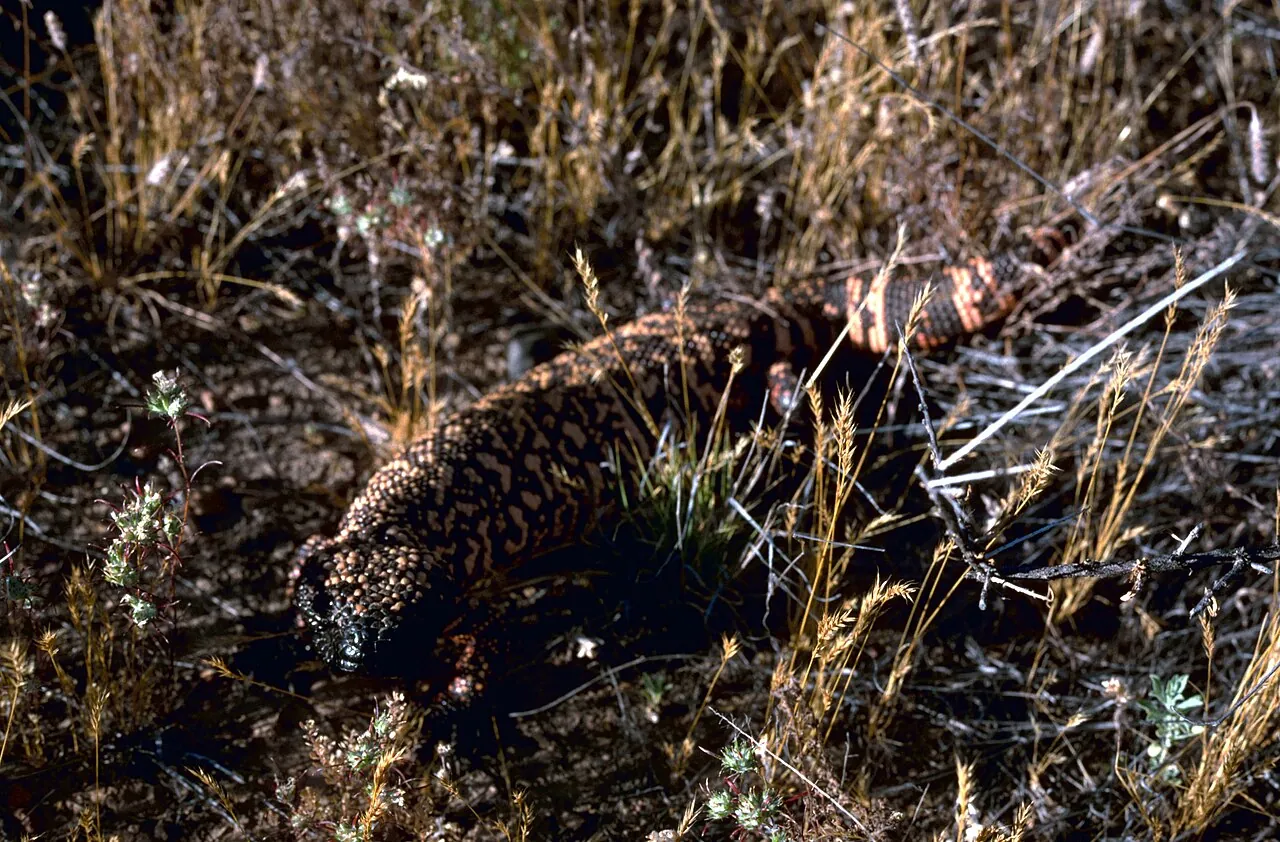
A lizard helped us to get Ozempic, specifically the Gila monster, a big orange and black desert lizard.
Researchers already knew that some venoms could trigger insulin release, and insulin helps to move sugar out of your blood and into your cells. In the early 90s, Dr. John Eng wanted to find the specific molecules that could trigger this. In the Gila monster venom, they found the molecule called exendin-4.
And when researchers were testing this molecule, they realized that it follows that same pathway of the after-you-eat signal that humans use. A molecule from a lizard was essentially pointing to a whole new way of treating blood sugar. How?
Your body already makes a hormone with a similar mechanism when you eat, called GLP-1. This is a molecule that helps to control insulin and your feeling of being full. But your body breaks it down in about two minutes. And so when you’re thinking about developing a drug, something that gets broken down in two minutes is not going to be ideal.
Exendin-4 was really important in this case because your body couldn’t break it down the same way. It actually lasted hours. And in 2005, scientists made a drug version of this called exenatide, which was sold under the name Byetta. And that was huge.
Drugs like this paved the way for medications like Ozempic, which, as we know, has been really groundbreaking in diabetes treatment and weight loss management. So we went from a desert lizard to a lab bench to a medicine cabinet.
That is why I will always ride for funding basic scientific research, because the science that you might think is totally weird and maybe even pointless could lead to huge medical breakthroughs like this.
Do you guys know about any other stories where it’s like, wait, that led to this science stories? Drop it in the comments. I’m Dr. Raven Baxter, your favorite scientist. Follow me for more science.
Your word of the day is
IN-suh-lin
Insulin. A hormone made in the pancreas that helps the body’s cells take in sugar from the blood.
| Word part | Comes from | Meaning |
|---|---|---|
| insul- | Latin insula | island |
| -in | New Latin -ina | an ending chemists use in names of compounds |
| homeo- (bonus word, homeostasis) | Greek hómoios | similar, like |
| -stasis (bonus word, homeostasis) | Greek stásis | a state of standing |
Same roots, other subjects
- History and geographyA peninsula is land almost surrounded by water. The word joins Latin paen-, “almost,” and insula, “island,” the same root as insulin.
- BiologyThe insula is a set of folds deep in the brain, and its name is Latin for island. Insulin takes its name from the islets of Langerhans, the tiny islands of cells in the pancreas that make the hormone.
- ChemistryPepsin, penicillin and aspirin end in the same chemistry ending -in, which marks proteins, medicines and other substances.
- PhysicsInsulate comes from Latin insulātus, “made into an island.” Insulating material reduces the passage of heat, electricity or sound.
- History and civicsInsular means cut off from others or narrow-minded, like people living apart on an island. The word comes from Late Latin insulāris, from insula.
- World languagesSpanish says insulina and French says insuline. Latin insula became isla in Spanish, île in French and isola in Italian.
- Biology, bonus wordHomeostasis joins Greek hómoios, “similar,” and stásis, “standing.” Hemostasis, the stopping of bleeding, joins hemo-, from the Greek word for blood, with stasis.
- Engineering, bonus wordA thermostat keeps a room at a steady temperature. Its name joins Greek thermos, “heat,” and statos, “a standing,” the same idea of standing still that stasis carries.
Word hunt. Ask students to find three more proteins, medicines or other chemicals whose names end in -in and say what each one does.
Dictionary.com traces insulin to Latin insula, “island,” plus the chemistry ending -in. The hormone takes its name from the islets of Langerhans, the clusters of cells in the pancreas that make insulin. Raven names insulin in the video. Homeostasis, the bonus word, ties to the thermostat and feedback questions. The worksheets carry a short version. Use these for discussion or a word hunt.
Lesson flow
- 3 minPredictStudents answer the question and write one sentence.
- About 2 minVideo
- 4 minWord of the dayBreak the word into its parts together.
- 8 minQuestionsStudents answer on their own, then share out. With partners, pairs discuss first.
- 5 minExit ticket
- 3 minPredictStudents answer the question and write one sentence.
- About 2 minVideo
- 4 minWord of the dayBreak the word into its parts together.
- 8 minQuestionsStudents answer on their own, then share out. With partners, pairs discuss first.
- Claim, evidence, reasoningThe high school worksheet asks harder Questions and adds claim, evidence, reasoning and Going further, about 15 more minutes in all.
- Going further
- 5 minExit ticket
- About 2 minVideo
- 4 minWord of the dayBreak the word into its parts together.
- 3 minPredictThe prediction takes the place of the opening question.
- About 20 minRead the paperStudents read the stability and binding data in the Deacon paper. The paper reading works as homework or a discussion section.
- 5 minExit ticket
Video simplifications
- Venom and insulin
- “Researchers already knew that some venoms could trigger insulin release.” The sources describe an earlier finding about the pancreas in general. NIH-supported scientists had found that some animal venoms affected the pancreas, the organ that also makes insulin. Eng’s 1992 paper tested exendin-4 on guinea pig pancreas cells that make digestive enzymes. The insulin link appears in 1993 work, including a study with Eng as co-author showing that exendin-4 acts on the GLP-1 receptor of insulin-making cells.
- Eng’s search
- “Dr. John Eng wanted to find the specific molecules that could trigger this.” Eng’s 1992 search followed the discovery of exendin-3 in the venom of a related lizard, Heloderma horridum. His team used a chemical test that picks out peptides starting with the amino acid histidine. Exendin-4 differs from exendin-3 at two of its 39 amino acids.
- Hours instead of minutes
- “Your body couldn’t break it down the same way. It actually lasted hours.” Resisting DPP-4 is part of the story. GLP-1 also leaves the blood through the kidneys, and kidney filtering is the main way exenatide leaves the body. Exenatide’s half-life is 2.4 hours.
- GLP-1’s half-life
- “Your body breaks it down in about two minutes.” Accurate. Reviews put GLP-1’s half-life at about 1 to 2 minutes, and at 1.5 to 2 minutes in people with type 2 diabetes.
- Exenatide in 2005
- “And in 2005, scientists made a drug version of this called exenatide, which was sold under the name Byetta.” The FDA approved exenatide in 2005, the first medicine to act on the GLP-1 receptor. Amylin Pharmaceuticals developed exenatide after Eng showed exendin-4 at an American Diabetes Association meeting.
- The path to Ozempic
- “Drugs like this paved the way for medications like Ozempic.” Accurate. The video doesn’t name the molecule in Ozempic or say what the molecule is made from. Semaglutide, the molecule in Ozempic, is based on human GLP-1 rather than on exendin-4. The Ozempic label lists a change at position 8 against DPP-4 and a fatty acid chain that binds albumin. Semaglutide shares 94% of its sequence with human GLP-1, has a half-life of about 1 week and was first approved in 2017 for adults with type 2 diabetes. The worksheets teach these facts from the label and the reviews, not from the video.
- The Gila monster
- “A big orange and black desert lizard.” Accurate. Gila monsters are black with pink or orange patterns, grow up to about 22 inches long and live in the southwestern US and northwestern Mexico.
- The early 90s
- “In the early 90s.” Accurate. Eng’s exendin-4 paper came out in 1992, and the Golden Goose Award dates the discovery to 1992.
- Pronunciation
- Gila is HEE-luh.
Worksheet
Predict
The Gila monster is a big orange and black lizard with a venomous bite. Its venom holds a molecule that works like a hormone your body makes after you eat. Could a molecule from lizard venom lead to a medicine for people?
Circle one. Yes / No
Watch
- Ozempic exists because of a LIZARD!youtube.com/shorts/3CZu2rwL4NQ
Word of the day
Insulin (IN-suh-lin). A hormone that helps move sugar from your blood into your cells. Tiny islands of cells in your pancreas, called islets, make insulin.
| Word part | Comes from | Meaning |
|---|---|---|
| insul- | Latin insula | island |
| -in | New Latin -ina | an ending for names of chemicals |
- A peninsula is land with water almost all the way around. Peninsula comes from Latin paen-, “almost,” and insula, “island.”
- Insulation in a wall keeps heat from passing through. Insulate comes from Latin for “made into an island.”
Bonus word. Homeostasis (hoh-mee-oh-STAY-sis). Your body keeps the conditions inside it steady, even when conditions outside change. Homeo- means similar, and -stasis means standing. A thermostat keeps a room at a steady temperature in the same way.
Questions
Insulin is a hormone, a chemical messenger that travels in your blood. Insulin helps move sugar out of your blood and into your cells. After you eat, your gut makes another hormone called GLP-1, and GLP-1 signals your pancreas to release more insulin. Why does your body release more insulin after you eat?
Hint. What goes up in your blood after a meal?
Your body breaks down GLP-1 in about 2 minutes. A thermostat turns the heat on when a room gets cold and turns the heat off when the room warms up. Why would a GLP-1 signal that shuts off within a few minutes help your body?
Hint. What could happen to your blood sugar if insulin kept rising long after a meal?
Exendin-4 is a molecule from Gila monster venom. Exendin-4 works like GLP-1, but exendin-4 lasts for hours instead of minutes. Why was a molecule that lasts for hours such a big deal for treating high blood sugar?
Hint. Could a signal that disappears in 2 minutes work as a medicine?
Ozempic is the brand name of a medicine called semaglutide. Scientists made semaglutide by changing human GLP-1, and no part of semaglutide comes from lizard venom. Ozempic didn’t come from a lizard. How did Gila monster research still help lead to Ozempic?
Hint. Exenatide, a lab-made copy of exendin-4, became a medicine in 2005. Ozempic was approved in 2017. Which medicine came first?
Exit ticket
Exendin-4 and GLP-1 work the same way in the body, but exendin-4 lasts much longer. GLP-1 starts with the building blocks H, A and E. Exendin-4 starts with H, G and E. An enzyme called DPP-4, a protein that cuts other molecules, cuts these two quickly when the second building block is A. What tiny difference between exendin-4 and GLP-1 makes exendin-4 last longer?
Hint. Compare the second building block of each molecule.
Predict
The Gila monster is a big orange and black lizard with a venomous bite. Its venom holds a molecule that works like a hormone your body makes after you eat. Could a molecule from lizard venom lead to a medicine for people?
Circle one. Yes / No
Watch
- Ozempic exists because of a LIZARD!youtube.com/shorts/3CZu2rwL4NQ
Word of the day
Insulin (IN-suh-lin). A hormone made by clusters of cells in the pancreas called the islets of Langerhans. Insulin helps cells take in sugar from the blood.
| Word part | Comes from | Meaning |
|---|---|---|
| insul- | Latin insula | island |
| -in | New Latin -ina | an ending chemists use in names of compounds |
- A peninsula is land almost surrounded by water. Peninsula joins Latin paen-, “almost,” and insula, “island.”
- Pepsin, penicillin and aspirin end in the same chemistry ending -in.
Bonus word. Homeostasis (hoh-mee-oh-STAY-sis) means a living thing keeps its internal conditions steady while conditions outside change. The word joins Greek hómoios, “similar,” and stásis, “standing.” Hemostasis, the stopping of bleeding, ends with the same root.
Questions
After a meal, cells in your gut release GLP-1. GLP-1 boosts insulin release when blood sugar is high, and the enzyme DPP-4 in the blood breaks GLP-1 down within about 2 minutes. How do these steps work together as a feedback loop that keeps blood sugar in a steady range?
Hint. Trace what happens as blood sugar rises after the meal and then falls. When does the insulin boost stop?
In 1993, a team that included John Eng tested exendin-4 on insulin-making cells from rats. Exendin-4 pushed labeled GLP-1 off the GLP-1 receptor. Exendin-4 also raised cAMP, a messenger molecule inside the cells, as GLP-1 does, and boosted insulin release when sugar was present. What do the three results show about how exendin-4 acts on insulin-making cells?
Hint. A receptor is a protein that a hormone binds. What does it mean if exendin-4 can take GLP-1’s place on the receptor and then trigger the same response?
Gila monsters make their own GLP-1 in the pancreas and gut. In 1997, Chen and Drucker found that exendin-4 comes from a separate gene, used only in the lizard’s salivary glands. About 53% of exendin-4’s first 30 amino acids match GLP-1. Is exendin-4 the Gila monster’s own GLP-1? Use the gene evidence to back up your answer.
Hint. Two proteins can look alike and still come from different genes. Which gene makes each protein, and where is each gene used?
Semaglutide, sold as Ozempic, shares 94% of its amino acid sequence with human GLP-1. Exendin-4 shares about 53% of its first 30 amino acids with GLP-1. Why do scientists say Ozempic didn’t come from a lizard? And what did the lizard research add on the way to Ozempic?
Hint. Compare the two percentages. Then compare the years. Exenatide, a lab-made copy of exendin-4, was approved in 2005, and Ozempic in 2017.
Claim, evidence, reasoning
GLP-1 lasts about 2 minutes in the body. Exenatide, a lab-made copy of exendin-4, lasts 2.4 hours. The enzyme DPP-4 cuts these molecules quickly when the second building block is alanine (A) or proline (P). GLP-1 has A in that spot, and exendin-4 has glycine (G). Why does exendin-4 last so much longer than GLP-1? Make a claim, back the claim with evidence and explain your reasoning.
Hint. Use the DPP-4 rule and the second building block of each molecule.
Going further
GLP-1 and exendin-4 boost insulin release when sugar is high. Scientists study this boost with insulin-making cells from animal pancreases, kept alive in dishes of liquid with sugar added. Plan an investigation to test whether exendin-4 boosts insulin release only when sugar is high. Name what you change, what you measure, what you keep the same and how many times you repeat each test.
Hint. You need dishes with low sugar and dishes with high sugar. Decide which dishes get exendin-4.
Exit ticket
Exendin-4 lasts for hours, and GLP-1 lasts about 2 minutes. GLP-1’s second building block is alanine, and exendin-4’s is glycine. How can one building block explain why exendin-4 lasts hours and GLP-1 lasts minutes? And how does a short-lived GLP-1 help keep blood sugar steady?
Hint. For the first part, think about which second building block DPP-4 cuts after quickly. For the second part, think about a thermostat.
Watch
- Ozempic exists because of a LIZARD!youtube.com/shorts/3CZu2rwL4NQ
Word of the day
Insulin (IN-suh-lin). A polypeptide hormone made by the beta cells of the islets of Langerhans in the pancreas that regulates the metabolism of glucose and other nutrients.
| Word part | Comes from | Meaning |
|---|---|---|
| insul- | Latin insula | island |
| -in | New Latin -ina | an ending chemists use in names of compounds |
- The insula, a set of folds deep in the brain, takes its name from the same Latin word for island.
- Pepsin, penicillin and aspirin end in the same chemistry ending -in.
Bonus word. Homeostasis, from Greek hómoios, “similar,” and stásis, “a state of standing,” names an organism’s tendency to regulate its internal conditions and hold them stable despite outside change. Hemostasis, the stopping of bleeding, shares stasis.
Predict
Natural GLP-1 had a half-life of 28 minutes in pig plasma in a test tube. Deacon’s team swapped GLP-1’s second amino acid, alanine, for glycine, the amino acid exendin-4 carries in that spot. Before you read the paper, take a guess. How many minutes did the glycine version of GLP-1 last in pig plasma? Give your reason in one sentence.
Hint. DPP-4 removes the first two amino acids of a chain quickly when the second amino acid is alanine or proline.
Read the paper
Deacon and others, “Dipeptidyl peptidase IV resistant analogues of glucagon-like peptide-1 which have extended metabolic stability and improved biological activity,” Diabetologia, 1998. The paper is free to read.
DPP-4, also called dipeptidyl peptidase IV, removes the first two amino acids of GLP-1 and inactivates the hormone. GLP-1’s chain is numbered from 7, which makes position 8 the second amino acid. The team made four versions of GLP-1, each with a different amino acid at position 8. They measured each version’s half-life in pig plasma in a test tube at 37°C, reported in the Results section, and how tightly each version bound the human GLP-1 receptor, reported in Table 3. IC50 is the concentration of a version that displaces half of the labeled GLP-1 from the receptor, and a lower IC50 means tighter binding.
| Version of GLP-1 | Amino acid at position 8 | Half-life in pig plasma (min) | Times longer than GLP-1 | Receptor binding, IC50 (nmol/l) |
|---|---|---|---|---|
| Natural GLP-1 | Alanine | 28.1 | 1 | 0.78 |
| Gly8 | Glycine | 159 | 2.8 | |
| Ser8 | Serine | 174 | 9.0 | |
| Thr8 | Threonine | 197 | 49 | |
| Aib8 | Aib, a lab-made amino acid | No breakdown detected after 6 hours | 0.45 |
Quantitative reasoning To fill in the Times longer column, divide each version’s half-life by natural GLP-1’s half-life of 28.1 minutes. For Aib8, use 6 hours as the shortest possible half-life. How many times longer did each version last than natural GLP-1? And why can you give only a minimum for Aib8?
Hint. Change 6 hours into minutes first. Deacon’s team saw no breakdown of Aib8 during those 6 hours.
Structure and function A medicine based on GLP-1 needs to resist DPP-4 and still bind the GLP-1 receptor. Exendin-4 carries glycine at this spot, and semaglutide, sold as Ozempic, carries Aib. Which version of GLP-1 in the table best meets both needs? And what does the threonine version show about the cost of changing position 8?
Hint. A lower IC50 means tighter binding. Divide threonine’s IC50 by natural GLP-1’s IC50.
Process of science In living pigs, Deacon’s team measured a half-life of 0.9 minutes for intact GLP-1 and 3.3 to 3.9 minutes for the new versions. In the test tube, the half-lives ran from 28 to 197 minutes. Why might the half-lives in living pigs be so much shorter than in the test tube? And what does the gap say about test tube results?
Hint. A test tube of plasma holds DPP-4. What organs does a living pig have that a test tube lacks?
Science and society Deacon’s team included scientists from the University of Copenhagen and from Novo Nordisk, the company that later brought semaglutide to market as Ozempic. The Danish Medical Research Council and the Danish Biotechnology Programme funded the study. What does each partner add to a study like Deacon’s? And what would you check before trusting a study with company co-authors?
Hint. Think about who makes medicines and who checks results. Then look at the paper’s methods and funding.
Exit ticket
Deacon’s Results section and Table 3 report how long each version of GLP-1 lasted in pig plasma and how tightly each version bound the GLP-1 receptor. What do these data show? And what’s one question these data can’t answer?
Hint. Start with your Times longer column. Then think about what a test tube of pig plasma leaves out.
Standards
The lesson builds toward three Next Generation Science Standards (NGSS), the most widely used US science standards. Some states, like Texas and Virginia, write their own. NGSS covers kindergarten through grade 12. The college worksheet uses the AAAS Vision and Change framework for undergraduate biology. MS-LS1-3 assessments cover six body systems, including the digestive and circulatory systems this lesson uses. The hormone signals in the lesson go beyond that list.
| Level | Standard | Lesson part | Practice | Crosscutting concept |
|---|---|---|---|---|
| Middle school | MS-LS1-3. Argue from evidence that the body is a system of interacting subsystems (core idea LS1.A) | Middle school worksheet, Questions 1 and 2 | Engaging in Argument from Evidence | Systems and System Models |
| High school | HS-LS1-1. Explain how the structure of DNA determines the structure of proteins, which carry out the functions of life (core idea LS1.A) | High school worksheet, Questions 3 and claim, evidence, reasoning | Constructing Explanations and Designing Solutions | Structure and Function |
| High school | HS-LS1-3. Plan and conduct an investigation showing that feedback mechanisms maintain homeostasis (core idea LS1.A) | High school worksheet, Questions 1 and Going further | Planning and Carrying Out Investigations | Stability and Change |
| College | Structure and function; systems. AAAS Vision and Change core concepts | College worksheet. Question 1 covers quantitative reasoning, question 2 structure and function, question 3 process of science and question 4 science and society. | Core competencies: quantitative reasoning; process of science; science and society | Core concept: structure and function |
Sources
This video draws on several research teams. The lesson credits each team.
| Topic | Who found it | Where it was published |
|---|---|---|
| Exendin-4 found in Gila monster venom | John Eng, an endocrinologist at the Bronx VA Medical Center, with W. A. Kleinman, L. Singh, G. Singh and Jean-Pierre Raufman | Journal of Biological Chemistry, 1992 |
| Exendin-4 acts on the GLP-1 receptor of insulin-making cells | R. Göke, H. C. Fehmann, T. Linn, H. Schmidt, M. Krause, John Eng and B. Göke | Journal of Biological Chemistry, 1993 |
| Exendin-4 comes from its own gene in the salivary gland | Y. E. Chen and D. J. Drucker | Journal of Biological Chemistry, 1997 |
| Gila monsters release exendin-4 when they bite | C. M. Christel and D. F. DeNardo | Comparative Biochemistry and Physiology A, 2006 |
| DPP-4 removes the first two amino acids quickly after proline or alanine | R. Mentlein, B. Gallwitz and W. E. Schmidt | European Journal of Biochemistry, 1993 |
| Changing GLP-1’s second amino acid slows its breakdown (the college worksheet paper) | C. F. Deacon, L. B. Knudsen, K. Madsen, F. C. Wiberg, O. Jacobsen and J. J. Holst, University of Copenhagen and Novo Nordisk | Diabetologia, 1998 |
| GLP-1’s half-life and the history of GLP-1 medicines | Reviews by Drucker, Habener and Holst, and by T. D. Müller and colleagues | Journal of Clinical Investigation, 2017 and Molecular Metabolism, 2019 |
| Exenatide and semaglutide structure, half-life and approval | US Food and Drug Administration prescribing labels | Byetta label and Ozempic label |
The Eng, Chen, Mentlein and Deacon papers, both reviews and both labels are free to read.
- Research papers, reviews and FDA labels, linked in the table above
- Golden Goose Award, John Eng awardee page and 2013 announcement, for Eng’s work at the Bronx VA, the 1992 discovery and the path to Byetta
- Jake Currie, “How the Gila Monster Gave the World Ozempic,” Nautilus, 2026, for Eng’s title as an endocrinologist
- Smithsonian’s National Zoo, Gila monster
- UniProt P01275, the human proglucagon sequence, for GLP-1’s first five amino acids
- Vision and Change core concepts and competencies, as summarized in Brownell and others, CBE Life Sciences Education, 2014
- Word origins from Dictionary.com: insulin, -in, insula, insular, homeostasis, homeo-, stasis, peninsula, hemostasis, hemo-, thermostat, insulate, homeomorphism, Gila monster
- Spanish, French and Italian spellings from Wiktionary: insula, insulin
- NGSS MS-LS1-3, HS-LS1-1, HS-LS1-3