Teacher guide
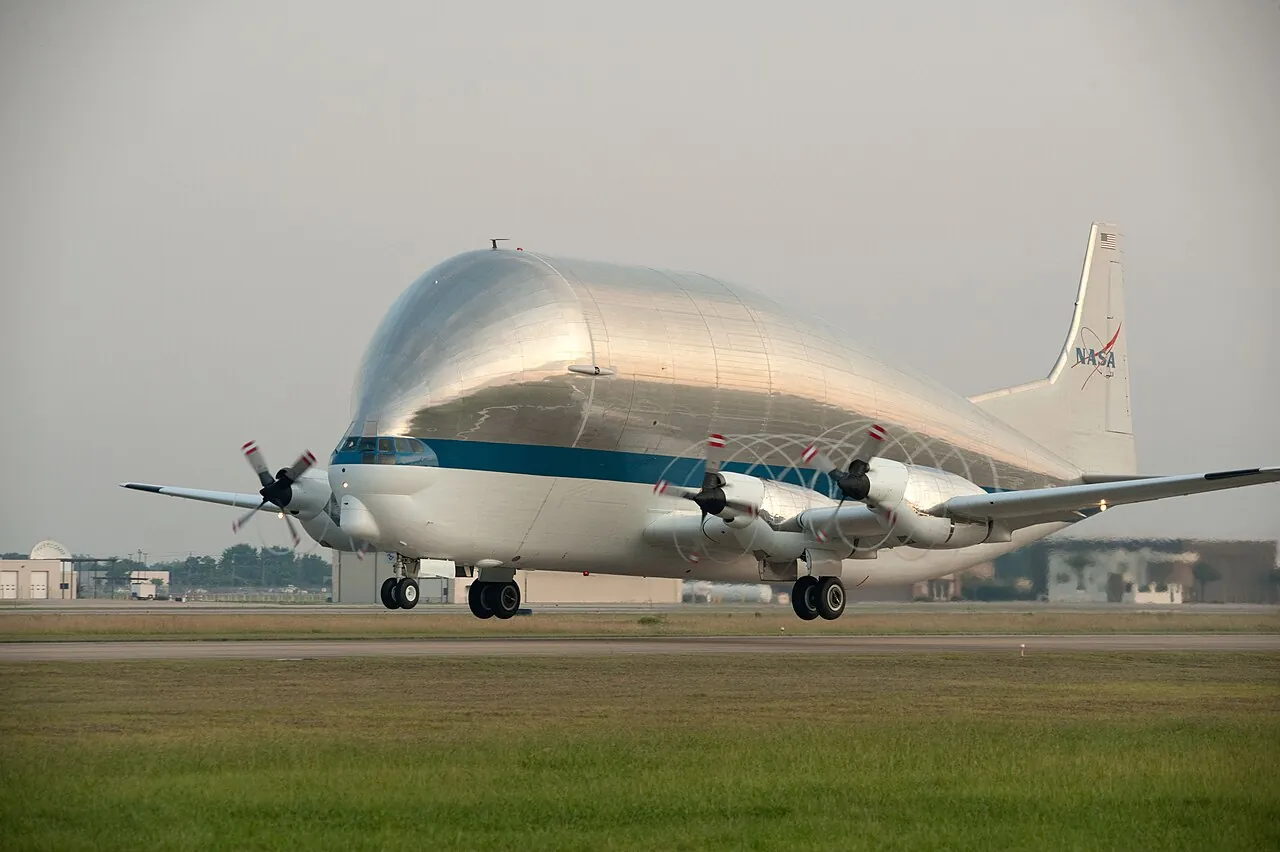
NASA has a plane that looks like it swallowed another plane. The Super Guppy’s cargo bay is about 25 feet wide, and NASA flies rocket and spacecraft parts inside. Those parts are built in many places, some are 15 to 20 feet wide, and many are too fragile for long trips on bumpy highways. Students work out the limits on moving those parts, why the plane opens at the nose and why room inside beats lifting power. Then they decide how NASA should move a huge, fragile part. High school students also plan the Orion spacecraft’s 2019 trip to Ohio and see how data from one flight changed NASA’s rules for protecting cargo.
At a glance
- Middle school
- Grades 6 to 8 · About 22 minutes
- High school
- Grades 9 to 12 · About 34 minutes · A calculator
- College
- College · About 35 minutes · A calculator
- Materials
- The worksheet for your level and a screen for the video. High school and college students need a calculator.
- Grouping
- Students work alone. For partners, pair students for Questions.
- Phenomenon
- NASA builds rocket and spacecraft parts in many states, and then the parts have to come together for launch. Some are 15 to 20 feet wide and easy to damage. NASA flies many of them in the Super Guppy. Its cargo bay is 25 feet wide, 25 feet tall and 111 feet long, and its nose swings open for crews to roll cargo straight in.
- Topics
- Engineering design, criteria and constraints, fit checks, choosing among competing solutions, protecting fragile cargo, NASA rocket and spacecraft hardware, the Space Launch System (SLS) and Orion.
Preview the video before sharing it with your class.
Video and transcripts
- 1
Have you heard of the Super Guppy?
Introduces NASA’s Super Guppy cargo plane and why NASA uses the plane. Aerospace engineer Naia Butler-Craig speaks in the video. The Instagram caption congratulates her on finishing her PhD in aerospace engineering.
Watch on YouTubeTranscript
Transcribed from the posted video on YouTube.
NASA has a plane that looked like it swallowed.
Previously, from Raven the Science Maven. They had the NASA guppy in the background. Have you heard of the guppy?
No.
It’s a NASA airplane.
Meet Dr. Naia Butler-Craig, an aerospace engineer, NASA fellow, and a leading voice for the next generation of STEM, fresh off her PhD from Georgia Tech.
The NASA guppy, it looks like a literal whale. It has this huge cargo bay for transporting things that cannot be driven places.
NASA has a plane that looks like it swallowed another plane, and it should not be able to fly. But it does. It does. Let’s talk about the Super Guppy. Yes, it’s called the Super Guppy. That’s its actual name. I did not make it up.
Here’s the thing. A lot of times, when you see a rocket that is going to space, those parts of the rocket, the individual parts, may not have been built all in the same place. Many times, the parts are built in different parts of the country, even different parts of the world, for example.
Some of these parts are about 15, 20 feet wide, and they are way too big for regular cargo planes, and also way too fragile for potholes on bumpy highways over hundreds if not thousands of miles. So, they built a plane with a giant bulge in the middle. The cargo area is about 25 feet wide, and that’s wider than a school bus long. It’s pretty big.
Now, probably the coolest thing about this thing is that the plane actually opens on a hinge. Like, in half. It hinges 110 degrees to the side. So, they literally are driving the spacecraft inside of the plane.
This one plane has carried pieces of the space station in [unclear] every moon capsule in the past 20 years. That’s incredible.
Anyway, follow me for more fun NASA facts. I got to see the Super Guppy in person. It was really cool. Let me know y’all’s thoughts in the comments, and follow me for more fun. Bye!
Your word of the day is
air-uh-NAW-tiks
Aeronautics. The design, construction and operation of aircraft, and the study of flight through the air.
| Word part | Comes from | Meaning |
|---|---|---|
| aero- | Greek āḗr | air |
| naut- | Greek naûs, by way of nautikós | ship |
| -ics | Latin -ica, from Greek -ika | a science or field of study |
| fuselage (bonus word) | French fuselé, from fuseau | spindle-shaped, from spindle |
Same roots, other subjects
- History and artIn Greek myth, the Argonauts sailed with Jason on the ship Argo to find the Golden Fleece. Their name means “crewman of the ship Argo.”
- BiologyAerobic living things need air or free oxygen to live.
- ChemistryAn aerosol is a mix of tiny particles spread through a gas, such as smoke, fog or mist. The name joins aero- with sol, short for solution.
- MathA nautical mile is 1,852 meters, the average length of one minute of latitude. A minute is 1/60 of a degree.
- MusicAny wind instrument, such as a flute or a trumpet, is an aerophone, from aero- and -phone.
- HealthNausea comes from a Greek word for seasickness, formed from naûs, “ship.”
- World languagesFrench says aéronautique. Russian says kosmonávt, which English borrowed as cosmonaut, a Russian or Soviet astronaut.
Word hunt. Ask students to find three more words with aero- or naut and say what each word has to do with air or with ships.
The word joins Greek roots for air and ship, and English took the word in the 1820s from New Latin aeronautica or French aéronautique. Aeronautics is the A in NASA, the National Aeronautics and Space Administration. The bonus word, fuselage, names the main body of a plane, the part Aero Spaceline Industries made so wide on the Super Guppy. Dictionary.com traces fuselage to the Latin word for spindle, which describes the tube shape of a plane’s body. The worksheets carry a short version. Use these for discussion or a word hunt.
Lesson flow
- 3 minPredictStudents answer the question and write one sentence.
- Under 2 minVideo
- 4 minWord of the dayBreak the word into its parts together.
- 8 minQuestionsStudents answer on their own, then share out. With partners, pairs discuss first.
- 5 minExit ticket
- 3 minPredictStudents answer the question and write one sentence.
- Under 2 minVideo
- 4 minWord of the dayBreak the word into its parts together.
- 8 minQuestionsStudents answer on their own, then share out. With partners, pairs discuss first.
- About 5 minClaim, evidence, reasoning
- About 7 minGoing furtherQuestion 1 asks students to break Orion’s 2019 round trip to Ohio into legs and justify each one. Question 2 shows how data from one flight changed NASA’s rules for protecting cargo.
- 5 minExit ticket
- Under 2 minVideo
- 4 minWord of the dayBreak the word into its parts together.
- 3 minPredict
- 20 minRead the paperStudents read Sections 5, 6.2, 6.4, 6.8 and 6.9 and Figure 14 of NASA’s Super Guppy user’s guide, fill in the table and answer the questions. The reading works as homework or a discussion section.
- 5 minExit ticket
Video simplifications
- Conflicting NASA numbers
- NASA’s own pages disagree on several Super Guppy numbers. Check any number in the video against this list. The lesson uses the user’s guide, the document NASA’s Super Guppy team writes for customers planning a flight.
- School bus comparison
- The video says the cargo area is about 25 feet wide and calls that “wider than a school bus long.” The comparison is off. A full-size school bus is about 35 to 45 feet long, longer than the bay is wide. If students repeat the line, correct the comparison.
- How wide the bay is
- The middle and high school worksheets use the rounded 25 feet from NASA’s aircraft page and the video. The college reading goes further. Figure 14 of the user’s guide gives the round upper bay a radius of 144 inches, or 24 feet across inside, and NASA’s drawing gives 26 feet across the outside of the body. With the guide’s 6-inch minimum clearance on each side, the widest part that fits is about 23 feet, and NASA prefers about 22 feet. Wide parts ride on raised supports because the bay narrows near the floor.
- Widths on the high school worksheet
- NASA gives the Orion heat shield, on the bottom of the crew module, as 16.5 feet wide. The crew module is a cone with the heat shield at its base, its widest point. The high school worksheet uses the same width for the Orion spacecraft. The high school exit ticket compares the heat shield with a regular truck load. The Federal Highway Administration sets 102 inches, about 8.5 feet, as the width limit on the National Network of highways and counts cargo in that width. Wider loads need a permit.
- How the plane flies
- The video calls the Super Guppy a plane that “should not be able to fly.” The line is a hook, and the video never explains how the plane flies. The lesson stays on the problem the video does teach, moving huge, fragile parts built in many places. If your class wants the physics, NASA Glenn Research Center’s Beginner’s Guide to Aeronautics explains the four forces on an airplane.
- Cargo weight
- The user’s guide (May 2023) sets the allowable cabin load at 48,000 pounds in the best flight conditions, with 36,000 pounds more likely on some routes. NASA’s aircraft page lists a useful load of 45,000 pounds. NASA articles from 2014 and 2016 say more than 26 tons, and a 2022 Marshall article says more than 48,000 pounds.
- Nose opening
- NASA’s aircraft page and the 2022 Marshall article say the nose opens 110 degrees. The 2014 and 2016 articles say more than 200 degrees. The user’s guide says an electric outrigger rotates the swing nose 100 degrees.
- Engines
- NASA’s aircraft page names Allison 501-D22C turboprops in its specifications and Allison T-56 turboprops in its history. The user’s guide resolves the mismatch. The Allison 501-D is the commercial version of the T56 engine.
- Which Guppy
- NASA flies the Super Guppy Turbine, the last of four built. Its airframe began as a KC-97 in service from 1953 and first flew as a Super Guppy Turbine on June 21, 1983. Airbus flew it in Europe until NASA took it over on October 23, 1997, under an International Space Station barter agreement. The original Super Guppy, introduced in 1965, served NASA programs for 32 years. The Pregnant Guppy came first, in 1961.
- Pronunciation
- Aeronautics is air-uh-NAW-tiks. Fuselage is FYOO-suh-lahzh.
Worksheet
Predict
Some rocket parts are 15 to 20 feet wide. They’re too big for regular cargo planes. They’re also too fragile for a long, bumpy ride down the highway. Could a plane carry a rocket part that big inside its body?
Circle one. Yes / No
Watch
- Have you heard of the Super Guppy?youtube.com/shorts/VzgMYgg4Fwc
Word of the day
Aeronautics (air-uh-NAW-tiks). The science of flight. You’ve seen this word before, hiding in the A of NASA, the National Aeronautics and Space Administration.
| Word part | Comes from | Meaning |
|---|---|---|
| aero- | Greek āḗr | air |
| naut- | Greek naûs | ship |
| -ics | Greek -ika | a science or field of study |
- An astronaut travels in space. Break the word apart and you get astro-, “star,” plus the naut of aeronaut.
- A flute is an aerophone, an instrument you play with air.
Bonus word. Fuselage (FYOO-suh-lahzh). The fuselage is the main body of a plane, and the Super Guppy’s fuselage is extra wide. The word comes from the Latin word for spindle, after the plane’s tube shape.
Questions
Some rocket parts are too big to travel by road or train. Tunnels, narrow roads, low bridges and power lines all get in the way. How does the Super Guppy get giant rocket parts past tunnels, bridges and power lines?
Hint. Where does the rocket part ride? Where does the Super Guppy travel?
The video says some rocket parts are too fragile for potholes on bumpy highways. And the drive to the launch site can be hundreds or even thousands of miles long. What makes a long highway trip so risky for a fragile rocket part?
Hint. What does one pothole do to a fragile part? How many potholes does a truck hit in a thousand miles?
The Super Guppy’s entire nose swings open, and cargo rolls straight into the plane on rails. Why would a plane that hauls giant cargo open at the nose instead of using a door on the side?
Hint. Picture a rocket part almost as wide as the Super Guppy’s body. Could that part squeeze through a door on the side?
Some cargo planes can carry heavier loads than the Super Guppy. But few cargo planes have as much room inside. Why would NASA pick the Super Guppy for a rocket part that’s huge but light?
Hint. What’s the problem with this rocket part, its size or its weight?
Exit ticket
Before moving a rocket part, NASA engineers check the part’s size, how fragile the part is and how far the part has to go. You’re the NASA engineer now. A fragile spacecraft part is 20 feet wide and has to travel 1,000 miles to Florida. How would you move the part, and what’s your reason?
Hint. Compare the part’s width with the Super Guppy’s 25-foot cargo bay. Then picture 1,000 miles of potholes.
Predict
Some rocket parts are 15 to 20 feet wide. They’re too big for regular cargo planes. They’re also too fragile for a long, bumpy ride down the highway. Could a plane carry a rocket part that big inside its body?
Circle one. Yes / No
Watch
- Have you heard of the Super Guppy?youtube.com/shorts/VzgMYgg4Fwc
Word of the day
Aeronautics (air-uh-NAW-tiks). Designing, building and flying aircraft, plus the study of flight through the air. It’s the A in NASA, the National Aeronautics and Space Administration.
| Word part | Comes from | Meaning |
|---|---|---|
| aero- | Greek āḗr | air |
| naut- | Greek naûs, by way of nautikós | ship |
| -ics | Latin -ica, from Greek -ika | a science or field of study |
- In Greek myth, the Argonauts sailed with Jason on the ship Argo. Their name means “crewman of the ship Argo.”
- Smoke and fog are aerosols, mixes of tiny particles spread through a gas.
Bonus words. Fuselage (FYOO-suh-lahzh) is the main body of a plane. The word comes from the Latin word for spindle, after the plane’s tube shape. A turboprop (TUR-boh-prop) is an engine where a gas turbine spins a propeller. The Super Guppy flies on four of them.
Questions
Engineers define a problem by its criteria, what a good solution must do, and its constraints, the limits a solution has to work within. The video says a rocket’s parts are often built in different parts of the country, even different parts of the world. Some parts are 15 to 20 feet wide. They’re too big for regular cargo planes and too fragile for hundreds or thousands of miles of potholes on bumpy highways. NASA has to bring all of these parts together in one place. Using the video, name one criterion and three constraints for that job.
Hint. A criterion describes success. A constraint is a limit, like the size of a part.
In the early 1960s, NASA shipped big rocket stages to Florida by barge, through the Gulf of Mexico or the Panama Canal. The trip took 18 to 25 days. NASA calls cargo like this oversized. Then, in 1961, came the Pregnant Guppy. The first Guppy plane was built to carry part of a Saturn rocket, and it made the same kind of trip in about 18 hours. Why did NASA need a new plane like the Pregnant Guppy instead of a regular cargo plane? And how many times faster was the flight than the fastest barge trip?
Hint. Could a regular cargo plane even fit a rocket stage? For the speed, change days to hours first.
The video says the Super Guppy’s nose hinges 110 degrees to the side, and crews drive the spacecraft straight into the plane. NASA’s user’s guide fills in the steps. A loader lifts the cargo up to the cargo floor, about 11 feet off the ground. Then a winch pulls the cargo in on rollers. Which constraint does the swing nose solve? And why would a regular side door fail for a spacecraft 16.5 feet wide?
Hint. How big an opening does each kind of door give you? Compare that with the width of the cargo.
Claim, evidence, reasoning
NASA’s Super Guppy started as a KC-97 airframe that went into service in 1953. Other cargo planes can carry more weight, but few match the Super Guppy’s cargo room. Answer with a claim, evidence and reasoning on the lines below. Why does NASA keep flying a plane this old instead of using the biggest modern cargo planes?
Hint. What does rocket hardware need most from a cargo plane, room or weight?
Going further: planning the trip
In 2019, NASA had to get the Orion spacecraft for Artemis I from Kennedy Space Center in Florida to NASA’s Plum Brook Station in Ohio for testing. Then Orion had to come back. NASA picked Mansfield Lahm Airport, 41 miles from Plum Brook Station by highway, as the Super Guppy’s landing site. You’re planning Orion’s trip. Break the round trip into legs. For each leg, pick how to move Orion and give one reason based on size, fragility or distance.
Hint. Start with the longest leg. Then figure out how Orion gets from the airport to the test site and back.
Sensors on the Super Guppy’s cargo rails recorded the airlift of the Orion spacecraft for Artemis I. During landing, the sensors measured a sideways push on the cargo. NASA’s rules for designing cargo supports hadn’t included a sideways push. NASA added one. Why would engineers change their rules for protecting cargo after reading sensor data from one flight?
Hint. What did the old rules assume? What did the flight show?
Exit ticket
For each rocket part, NASA weighs three constraints, size, fragility and distance, before picking how to move the part. Pick one rocket or spacecraft part from this lesson. Which way did NASA move the part, and how do its size, fragility and distance explain that choice?
Hint. Start with the part’s width. Then think about the length of the trip and the bumps along the way. Orion’s trip to Ohio makes a good example.
Watch
- Have you heard of the Super Guppy?youtube.com/shorts/VzgMYgg4Fwc
Word of the day
Aeronautics (air-uh-NAW-tiks). The design, construction and operation of aircraft, and the scientific study of flight through the atmosphere.
| Word part | Comes from | Meaning |
|---|---|---|
| aero- | Greek āḗr | air |
| naut- | Greek naûs, by way of nautikós | ship |
| -ics | Latin -ica, from Greek -ika | a science or field of study |
- In Greek myth, the Argonauts sailed with Jason on the ship Argo. Their name means “crewman of the ship Argo.”
- An aerosol is a system of tiny particles dispersed in a gas, such as smoke, fog or mist.
Bonus word. Fuselage (from French fuselé, “spindle-shaped”) names the central structure of an airplane, where the wing, tail surfaces and engines attach.
Predict
NASA’s aircraft page lists the Super Guppy’s cargo bay as 25 feet wide, and the video says about 25 feet too. Before you open NASA’s guide, make a prediction and give your reasoning in one sentence. How wide, in feet, is the widest part you think the Super Guppy can carry?
Hint. Picture the shape of the bay. How much space does a part need around its edges?
Read the paper
NASA Johnson Space Center Aircraft Operations Division, Super Guppy Transport User’s Guide, AOD 33973 Rev C, May 2023. The guide is free to read.
NASA’s Aircraft Operations Division in Houston flies the Super Guppy and wrote this guide for teams that want to ship hardware on the plane. Teams use the guide to check whether a part fits and to plan how the part gets loaded and protected. Read Section 5, Sections 6.2 and 6.4, Figure 14, Section 6.8 and Section 6.9. Figure 14 shows the cargo bay’s cross section. The round upper part has a radius of 144 inches, and its center sits 155 inches above the cargo floor. Below the circle, the bay narrows toward the floor. Section 6.4 requires at least 6 inches of clearance between cargo and the plane’s body, and NASA prefers 12 inches. Table 1 sets the allowable cabin load at 48,000 pounds, counting the payload, pallets and adapters. Fill in the table, using 12 inches to the foot.
| Hardware | Width (feet) | Width (inches) | Fits with 12 inches of clearance on each side? |
|---|---|---|---|
| Orion heat shield | 16.5 | ||
| Orion stage adapter | 18 | ||
| SLS core stage | 27.6 | ||
| SLS booster segment, 180 tons | 12 |
Outcome 1, solving engineering problems The bay is widest across the circle with a 144-inch radius. NASA prefers that a part clear the plane’s body by 12 inches on each side. With 12 inches of clearance on each side, how wide a part can the Super Guppy take? Which parts in the table pass that width check? And which part passes on width but fails another limit in the guide?
Hint. Double the radius, then subtract the clearance on both sides. For the last part, compare its weight with the 48,000-pound allowable cabin load in Table 1.
Outcome 6, analyzing and interpreting data Section 5 says that because of the bay’s unique cross section, many payloads are too wide to fit directly on top of the pallet. They’re raised “so that the widest part of the payload fits within the widest part of the cargo bay.” In Figure 14, the center of the round upper bay sits 155 inches above the cargo floor, and the bay narrows below the circle. Why do wide payloads like the 198-inch Orion heat shield ride on raised supports? About how high should the shield’s widest part sit? And what does Section 5 ask of the structures that raise payloads?
Hint. Find where the bay is widest in Figure 14. Then read what Section 5 says those structures are sized to do.
Outcome 7, acquiring and applying new knowledge Section 6.8 lists the flight, landing and crash conditions that cargo and its supports must be designed to survive. Footnote 17 says NASA added four flight and landing cases after the Artemis I airlift of the Orion crew and service modules, when accelerometers on the cargo rails showed a sideways push during landing. What did the Artemis I sensor data teach NASA about protecting cargo in the Super Guppy? And why should a design rule change after a measured flight?
Hint. What did the earlier flight and landing cases assume about sideways pushes?
Outcome 2, engineering design The Super Guppy’s cargo bay isn’t pressurized. Table 5 of the guide lists absolute air pressure of 14.70 psi at sea level and 6.75 psi at 20,000 feet, and missions typically plan for a top altitude of 18,000 feet. Sealed cargo must be analyzed for altitude pressure loads. Vented cargo needs vents sized for an emergency descent of 3,000 feet per minute, a pressure change of 1.55 psi per minute. A team is shipping a large, hollow spacecraft structure. Should the structure be sealed or vented? Write your recommendation in one paragraph that uses at least two numbers from the guide.
Hint. Find the pressure difference across a sealed wall at 20,000 feet. Then think about what a vent has to handle during an emergency descent.
Exit ticket
Section 5 of NASA’s Super Guppy user’s guide lists four planning questions for every payload. Will the payload fit inside? Can its weight be spread on the floor rollers within the floor limits? Can the payload be held in place for flight and crash conditions? Can the payload sit within the plane’s center of gravity limits? A width check answers which of the four planning questions? And why does NASA need the other three before a part can fly?
Hint. Remember the booster segment from the table, and the Artemis I sensor data.
Standards
The lesson builds toward four Next Generation Science Standards (NGSS), the most widely used US science standards. Some states, like Texas and Virginia, write their own. NGSS covers kindergarten through grade 12. All four come from engineering design, because the video poses an engineering problem, moving huge, fragile parts built in many places. The college worksheet uses the ABET student outcomes for accredited engineering programs. Why ABET for college. The biology lessons use AAAS Vision and Change, a framework for undergraduate biology. This lesson is engineering, and the college worksheet reads a NASA engineering document. ABET accredits college engineering programs. Its Criterion 3 lists seven student outcomes that every accredited program must document, and the college worksheet uses four of them. The outcomes come from the 2026-2027 Criteria for Accrediting Engineering Programs.
| Level | Standard | Lesson part | Practice | Crosscutting concept |
|---|---|---|---|---|
| Middle school | MS-ETS1-1. Define the criteria and constraints of a design problem with sufficient precision to ensure a successful solution, taking into account relevant scientific principles and potential impacts on people and the natural environment that may limit possible solutions (core idea ETS1.A) | Middle school worksheet, Questions and the exit ticket | Asking Questions and Defining Problems | Influence of Science, Engineering, and Technology on Society and the Natural World |
| Middle school | MS-ETS1-2. Evaluate competing design solutions using a systematic process to determine how well they meet the criteria and constraints of the problem (core idea ETS1.B) | Middle school worksheet, Questions 3 and 4 and the exit ticket | Engaging in Argument from Evidence | None listed for this standard |
| High school | HS-ETS1-2. Design a solution to a complex real-world problem by breaking it down into smaller, more manageable problems that can be solved through engineering (core idea ETS1.C) | High school worksheet, Going further question 1 | Constructing Explanations and Designing Solutions | None listed for this standard |
| High school | HS-ETS1-3. Evaluate a solution to a complex real-world problem based on prioritized criteria and trade-offs that account for a range of constraints, including cost, safety, reliability, and aesthetics as well as possible social, cultural, and environmental impacts (core idea ETS1.B) | High school worksheet, claim, evidence, reasoning and the exit ticket | Constructing Explanations and Designing Solutions | Influence of Science, Engineering, and Technology on Society and the Natural World |
| College | ABET Criterion 3. Student outcome 1 (solve complex engineering problems) and outcome 2 (apply engineering design) | College worksheet. Question 1 covers outcome 1, question 2 outcome 6, question 3 outcome 7 and question 4 outcome 2. | Student outcome 6 (experiment, analyze and interpret data) and outcome 7 (acquire and apply new knowledge) | ABET has no crosscutting concepts. |
Sources
This lesson draws on several NASA teams and reports and one federal highway agency. The lesson credits each one.
| Topic | Who wrote it | Where it was published |
|---|---|---|
| Cargo bay shape and clearance, loading, allowable cabin load, cargo design cases, temperature and air pressure in the bay | NASA Johnson Space Center Aircraft Operations Division, approved by division chief Raymond G. Heineman | Super Guppy Transport User’s Guide, AOD 33973 Rev C, May 2023 |
| Specifications and history, from the Pregnant Guppy to the Super Guppy Turbine | NASA Johnson Space Center Aircraft Operations Division | Super Guppy Oversize Cargo Transport, NASA web page |
| 131 NASA airlifts and why NASA keeps a large-cargo plane | John A. Bakalyar, NASA Johnson Space Center | NASA Technical Reports Server, 2018 presentation |
| Orion heat shield, 16.5 feet wide, built near Denver and flown to Kennedy in the Super Guppy | NASA | NASA, 2016 and Orion Fun Facts |
| Orion stage adapter, 18 feet wide, built at Marshall and flown to Kennedy in the Super Guppy | NASA | SLS Orion stage adapter and media advisory, 2018 |
| Orion stage adapter test article flown to Marshall | Corinne Edmiston, NASA Marshall Space Flight Center | NASA, 2022 |
| SLS core stage, 27.6 feet wide and 212 feet long, built at Michoud in New Orleans | NASA | SLS core stage, NASA reference page |
| The barge Pegasus and its core stage trips | NASA | NASA’s Pegasus Barge, NASA web page |
| Orion’s 2019 trip to Ohio, the 41-mile drive and more than 700 overhead lines cleared | NASA | NASA, 2019 and the flight back, 2020 |
| SLS booster segments, 12 feet wide and 180 tons each, by train from Utah | NASA | Solid rocket booster fact sheet and NASA, 2020 |
| Truck width limit of 102 inches, cargo included | Federal Highway Administration, U.S. Department of Transportation | Questions and Answers About Vehicle Size and Weight |
All of these sources are free to read. NASA’s aircraft page says very few aircraft “come close to its internal dimensions.” The word few, in place of none, shows students how carefully engineers word a claim.
- NASA documents and reports and the Federal Highway Administration page, linked in the table above
- More NASA articles on Super Guppy deliveries: Orion pressure vessel, 2016, composite test structure to Langley, 2014 and Orion transport fixture fit check, 2019
- For classes that want the physics of flight, NASA Glenn Research Center’s Four Forces on an Airplane
- ABET, Criteria for Accrediting Engineering Programs, 2026-2027, Criterion 3
- Word origins from Dictionary.com: aeronautics, aero-, nautical, -ics, astronaut, Argonaut, aerobic, aerosol, nautical mile, aerophone, nausea, cosmonaut, fuselage, turboprop
- Instagram original, posted March 2, 2026, not linked because Instagram needs a login
- NGSS MS-ETS1-1, MS-ETS1-2, HS-ETS1-2, HS-ETS1-3